

To sell on Etsy, open a shop, set honest shipping and processing policies, and list products that genuinely fit Etsy’s core categories — handmade goods, genuine vintage items (20+ years old), or craft supplies other makers buy. Photograph consistently against a clean background, use all 13 available search tags, and price to cover materials, your actual time, and Etsy’s three separate fees — not just materials cost, which is the most common pricing mistake new sellers make.
Fit the platform before fighting it
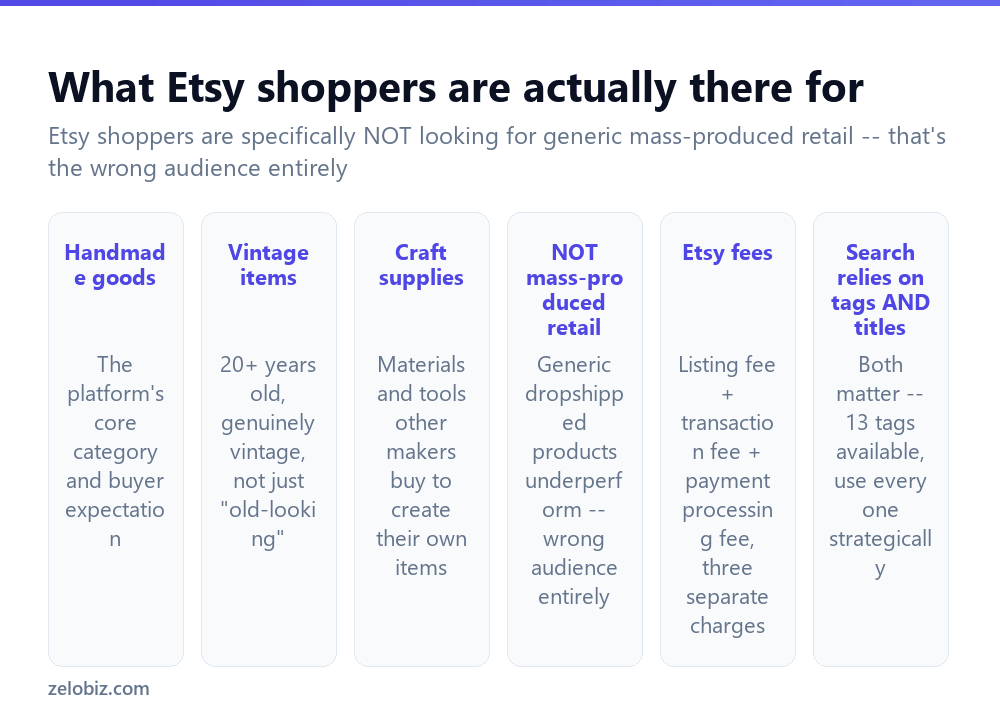
This matters more on Etsy than on most marketplaces, because its audience shops there with a specific expectation: handmade goods, genuine vintage items (Etsy’s own definition requires the item be at least 20 years old, not just styled to look old), or craft supplies that other makers buy to create their own products.
Generic mass-produced retail items — the kind of product that would do fine on Amazon or eBay — consistently underperform on Etsy, not because of any technical listing problem, but because the audience arriving on the platform is specifically looking for something else. Before investing significant effort in an Etsy shop, honestly assess whether your actual product fits what Etsy shoppers come there for.
If your product is genuinely handmade, vintage, or a craft supply, Etsy’s built-in audience is a real advantage over building traffic from scratch. If it isn’t, that same audience mismatch will work against you regardless of how well the listing itself is built.
Setting up your shop
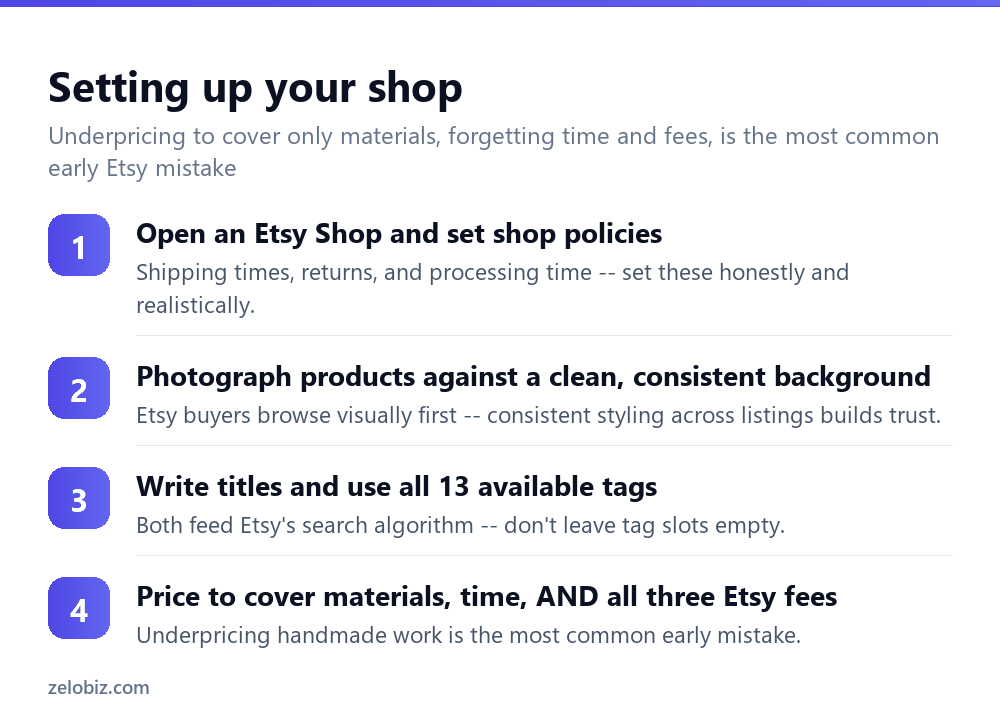
Open an Etsy Shop and set your shop policies — processing time (how long before an order ships), shipping timeframes, and return policy. Set these honestly based on your actual production and shipping capacity rather than optimistically; missing a promised processing time damages seller metrics more than a longer, accurately stated one ever would.
Photograph products against a clean, consistent background — Etsy is a heavily visual, browse-first marketplace, and consistent photo styling across your listings builds a sense of a cohesive, trustworthy shop rather than a scattered collection of one-off items.
Write titles and use all 13 available tags. Both feed Etsy’s search algorithm, and leaving tag slots empty is simply leaving searchable surface area unused — there’s no penalty for using all 13, only a cost to leaving some blank.
Price to cover materials, your actual time, and all of Etsy’s fees — covered in detail below, since underpricing handmade work is the single most common mistake new Etsy sellers make.
Etsy’s fee structure
Three separate fees apply to a typical Etsy sale, and all three need to be factored into pricing, not just the most obvious one.
Listing fee — a small flat fee charged per listing, for a set duration (typically four months) or until it sells, whichever comes first. This is charged regardless of whether the item sells.
Transaction fee — a percentage of the sale price (including shipping charged to the buyer), charged only when an item actually sells.
Payment processing fee — a percentage plus a small flat amount per transaction, covering the cost of actually processing the buyer’s payment, similar to a standard card-processing fee.
Together these add up to a meaningful chunk of the sale price, and it’s a genuinely common new-seller mistake to price based only on materials cost, discover the real payout after all three fees, and realize the actual margin barely covers materials with nothing left for the time invested making the item.
Pricing handmade work properly
A workable pricing approach: (materials cost) + (hours spent × a reasonable hourly rate for your time) + (a margin for profit) + (enough to cover all three Etsy fees at your target price), then check that total against what similar items on Etsy are actually selling for.
If the honestly-calculated price comes out well above what similar shops charge, that’s useful information about the market itself — it may mean the item needs to be produced more efficiently, or that this specific product isn’t well-suited to Etsy’s price expectations, rather than a sign to simply undercut and absorb the loss on your own time.
Standing out in Etsy search
Beyond tags and titles, Etsy’s search also weighs factors like listing “freshness” (recently listed or renewed items get some visibility boost), overall shop and listing engagement (favorites, views, and purchase conversion), and how well a listing’s text matches what a shopper actually typed.
Renewing older listings periodically, rather than letting them sit unchanged indefinitely, and writing titles and tags around the specific terms real buyers search (rather than internal or overly clever product names only you would recognize) both help meaningfully over time.
A worked example: launching a small jewelry shop
Say you make hand-formed silver earrings and are opening your first Etsy shop with a dozen initial designs.
Photograph each pair against the same clean, neutral background, in the same lighting setup, ideally including one shot showing scale against a hand or a common object — jewelry listings without a scale reference are a common source of buyer confusion about actual size. Write titles including the specific style (stud, hoop, drop), material (sterling silver), and any distinctive feature (hammered texture, a specific stone), then fill all 13 tags with a mix of those same specific terms and broader related searches (gift for her, minimalist jewelry, handmade earrings).
For pricing, calculate the silver cost, your actual working time per pair honestly estimated (not rounded down), a fair profit margin, and Etsy’s three fees at your target price point — then compare the result against what similar handmade silver earrings currently sell for on the platform. If your honestly-calculated price sits noticeably above the going rate, that’s a signal to look at production efficiency or materials sourcing before simply matching a lower competitor price and eating the difference out of your own labor.
Etsy Ads and when they’re worth using
Etsy offers paid promoted listings within its own search results, billed on a cost-per-click basis. For a brand-new shop with no sales history or reviews yet, this can help generate initial visibility and traffic, but it’s worth treating cautiously until you’ve confirmed the underlying listing (photos, pricing, description) actually converts browsers into buyers organically first — paying to send traffic to a listing that isn’t converting simply spends money faster without solving the underlying problem that’s actually holding the shop back.
When a shop isn’t getting sales
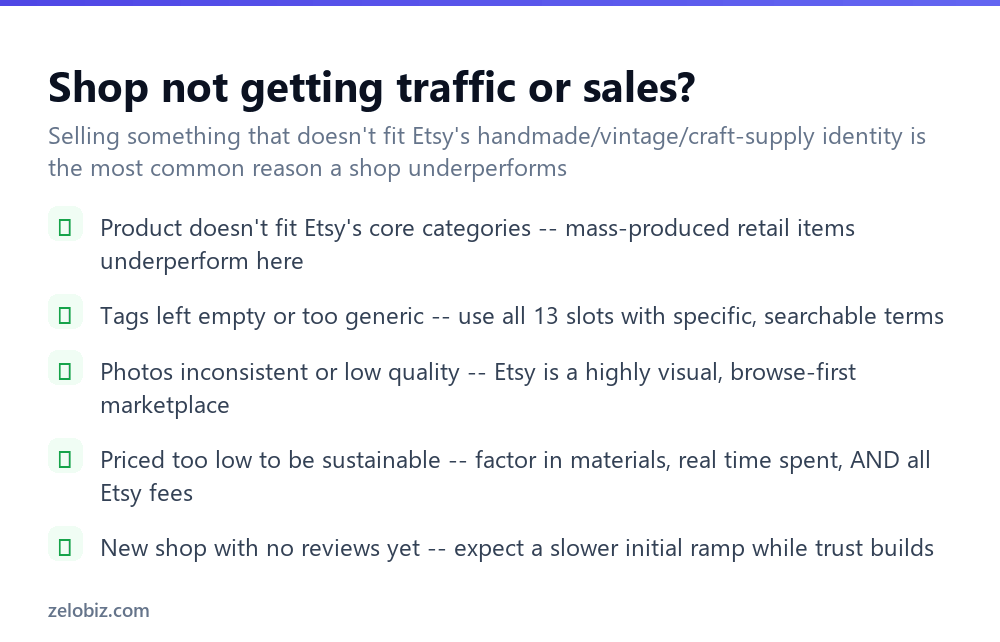
Product doesn’t fit Etsy’s core categories — honestly reassess whether what you’re selling matches what Etsy shoppers actually come looking for.
Tags left empty or too generic — use all 13 available tags with specific, searchable terms rather than vague ones or leaving slots unused.
Inconsistent or low-quality photos — revisit lighting and background consistency across the whole shop, not just individual listings in isolation.
Priced unsustainably low — recalculate factoring in real time spent and all three Etsy fees, not just materials cost.
A quick reference
Photos look fine individually but the shop feels disjointed: standardize background and lighting across every listing, not just the strongest ones. Priced competitively but still no sales: revisit tags and title specificity before assuming price is the problem. New shop, first month feels slow: that’s the normal ramp while reviews and trust build, not yet a sign something is wrong with the listings themselves.
- ✓Honestly assess whether your product fits Etsy’s handmade/vintage/craft-supply identity
- ✓Use all 13 available tags with specific, searchable terms
- ✓Price to cover materials, real time, and all three Etsy fees
- ✓Set honest processing and shipping timeframes based on real capacity
- ✓Photograph consistently across the whole shop, not listing by listing
- ✕Listing generic mass-produced retail items expecting Etsy’s audience to convert on them
- ✕Leaving tag slots empty when all 13 are available to use
- ✕Pricing based on materials cost alone, ignoring time and fees
- ✕Promising a processing time faster than you can consistently deliver
- ✕Letting listings sit unchanged indefinitely with no periodic renewal or review
Frequently asked questions
How do I start selling on Etsy?
Open a shop, set honest shipping and processing policies, list products that fit Etsy’s handmade, vintage, or craft supply categories, and use all available tags in your listings.
What fees does Etsy charge sellers?
A listing fee per item, a transaction fee (percentage of the sale) when it sells, and a payment processing fee — three separate charges that all need factoring into pricing.
What products sell well on Etsy?
Genuinely handmade goods, vintage items at least 20 years old, and craft supplies other makers buy. Generic mass-produced retail items consistently underperform on the platform.
How do I price handmade items for Etsy?
Add materials cost, your time at a reasonable hourly rate, profit margin, and enough to cover all three Etsy fees — then compare against what similar items actually sell for.
How many tags should I use on an Etsy listing?
All 13 available slots, with specific, searchable terms — there’s no penalty for using them all, only a cost to leaving some unused.
Why isn’t my Etsy shop getting any sales?
Common causes: the product doesn’t fit Etsy’s core categories, tags are unused or too generic, photos are inconsistent, or pricing doesn’t sustainably cover time and fees.
- →Compare against selling on eBay: how to sell on eBay
- →A larger-scale retail alternative: how to sell on Amazon
- →Sell physical products without holding stock: how to start a print on demand business
- →Build an audience alongside your shop: how to start a blog