
To start a print on demand business, choose a design niche, partner with a print on demand (POD) provider who prints and ships each order individually with no inventory held by you, upload designs sized correctly for each product, and list them with genuine descriptions. Your margin is the list price minus the provider’s base cost per item. Because the printing process and product templates are identical for every seller using the same provider, the design itself is the entire differentiator — there’s no other lever to compete on.
How print on demand actually works
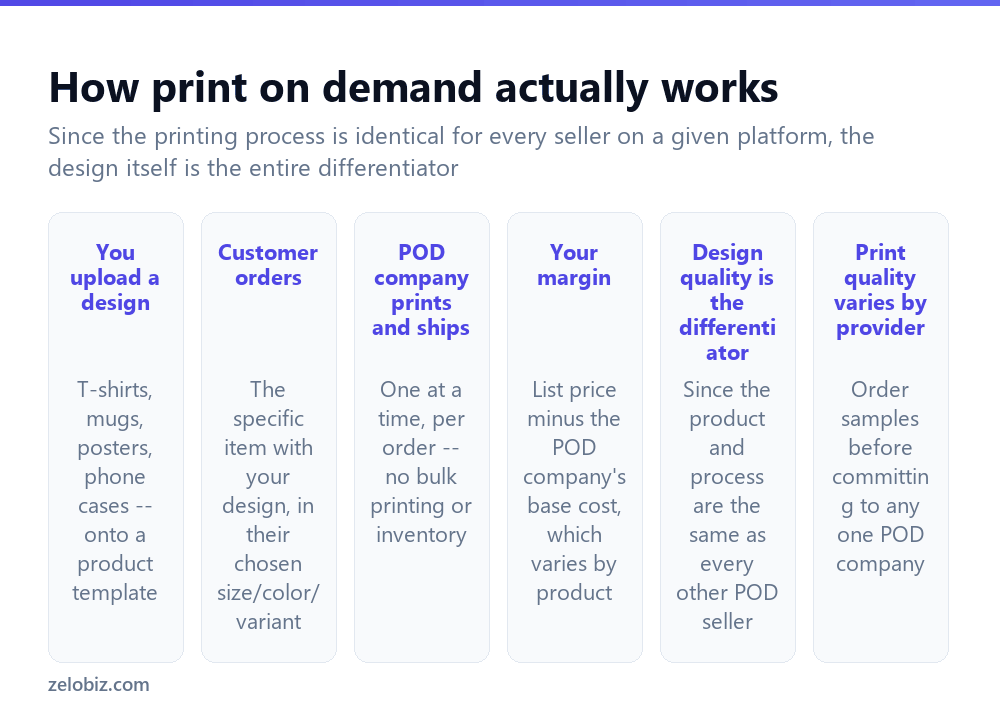
You upload a design onto a product template — a t-shirt, mug, poster, phone case, or similar. A customer orders that specific product with your design, choosing their size or color variant. The POD company prints and ships that single item, individually, only after the order is placed — there’s no bulk printing or inventory held anywhere in advance by you or the provider.
Your margin is the list price minus the provider’s base production cost for that specific product, which varies meaningfully by product type and the specific provider chosen.
Since the underlying printing process and blank product are essentially identical for every seller using the same POD provider, the design is the entire differentiator between your shop and any other seller’s using the same platform. This is different from dropshipping’s differentiation challenge — here, the product itself genuinely is unique to you, since it’s your specific design.
Print quality genuinely varies between POD providers, sometimes noticeably, even for the same product type. Ordering a physical sample from any provider before listing publicly is the only reliable way to confirm quality matches what you’re expecting your customers to receive.
Launching a shop
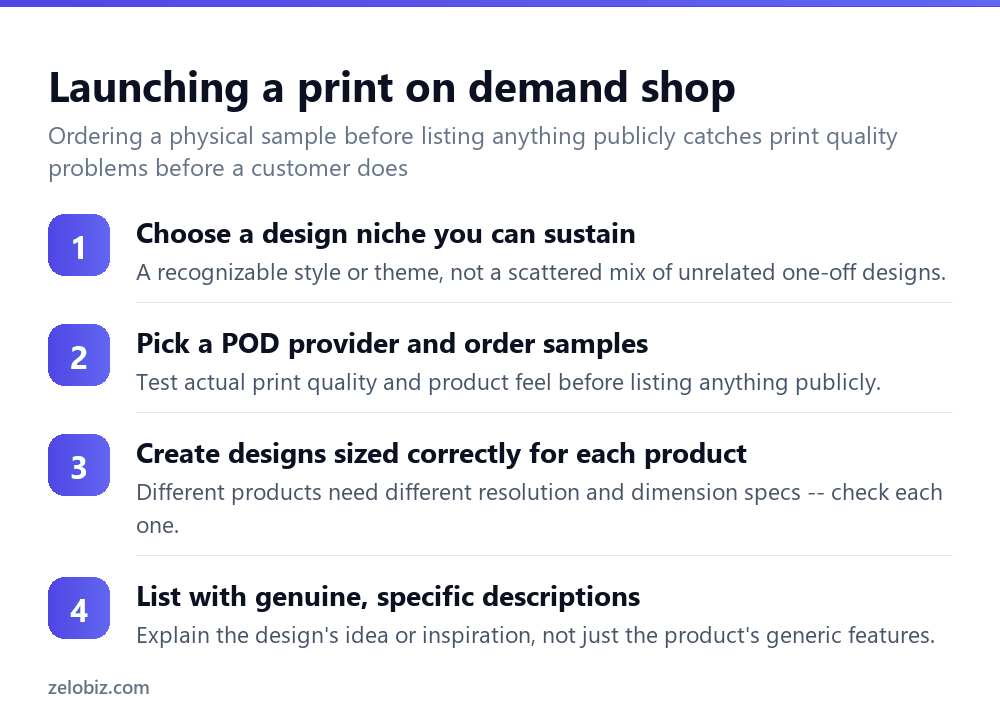
Choose a design niche you can sustain — a recognizable style or consistent theme, rather than a scattered mix of unrelated one-off designs with nothing tying the shop together. This helps build a recognizable identity and makes it easier for an interested buyer to browse the rest of the shop after finding one design they like.
Pick a POD provider and order samples of the actual products you plan to sell, checking real print quality, color accuracy, and product feel firsthand before listing anything for sale.
Create designs sized correctly for each specific product — different products have different resolution and dimension requirements, and a design sized for a t-shirt won’t automatically work correctly on a mug or a poster without adjustment.
Write genuine, specific listing descriptions — explaining the idea or inspiration behind a design, not just restating the product’s generic features, helps a browsing customer connect with it rather than treating it as one interchangeable item among many similar options.
Choosing a POD provider
Providers vary in their product range, base pricing, print quality, and integration options with platforms like Etsy or a self-hosted store. Beyond ordering a sample to check quality directly, compare base costs across providers for your specific planned products, since the gap between providers on the same item type can meaningfully affect your real margin at your chosen list price.
Shipping time and location coverage also vary by provider — worth checking against where your actual target customers are located, since a provider with strong US shipping but weak international coverage matters differently depending on your audience.
Design considerations beyond just “looking good”
A design needs to work at the actual print size and resolution the product requires, not just look good on a screen at a small preview size. Low-resolution source files that look fine as a thumbnail can print blurry or pixelated at full garment or poster size — check each provider’s specific resolution requirements for each product before finalizing artwork.
It’s also worth confirming a design doesn’t infringe on existing trademarks or copyrighted material, including fan art of existing franchises or characters, both from the platform’s own policy standpoint and to avoid a genuine legal issue — POD marketplaces generally enforce this and can remove infringing listings or suspend accounts.
Marketing: listings alone rarely generate traffic
Especially on a self-hosted store rather than an existing marketplace like Etsy, simply listing a well-designed product rarely generates meaningful traffic on its own. Some combination of social media presence showcasing the designs, relevant community engagement, or paid promotion is generally necessary to actually reach potential buyers, the same as with most other online retail.
A worked example: launching a small design shop
Say you’re an illustrator launching a print on demand shop around a recognizable line-art nature style — birds, plants, simple landscapes — across t-shirts, tote bags, and prints.
Before listing anything, order a t-shirt, a tote bag, and a print of the same design from your chosen provider. Check whether the line weight and detail that look crisp on screen survive the actual print process on each material — fine linework that reads clearly on a poster print can sometimes blur or lose definition on fabric, depending on the specific printing method the provider uses for that product.
Size each file according to the provider’s actual specifications for that specific product rather than using one master file resized generically for everything — a design built at print resolution for a large poster will generally scale down fine for a t-shirt, but the reverse (scaling a smaller file up) usually introduces visible quality loss.
Write listing descriptions that share something real about each piece — which bird species it depicts and why, what park or plant inspired a particular design — turning otherwise generic “bird t-shirt” search traffic into a buyer who feels a genuine connection to that specific piece rather than treating it as one interchangeable option among thousands of similar nature-themed products.
Diversifying across multiple platforms
Many successful print on demand sellers list the same designs across several platforms simultaneously — their own store, Etsy, and sometimes a marketplace with built-in POD integration — rather than relying on a single sales channel.
This spreads risk (a policy change or account issue on one platform doesn’t end the whole business) and reaches different audiences with different buying habits. It does add real overhead — keeping designs, pricing, and descriptions consistent across several storefronts takes genuine ongoing effort, and it’s generally worth establishing one platform first, confirming a design resonates with real buyers, before expanding the same catalog out to additional channels and taking on that extra coordination work.
A quick reference
Unsure whether a design will actually print well: order the sample before assuming — it’s the cheapest possible way to find out for certain. Considering listing on several platforms right away: start with one, confirm real buyer interest, then expand once the core design catalog has proven itself rather than spreading thin effort across many storefronts from day one.
When a shop isn’t selling
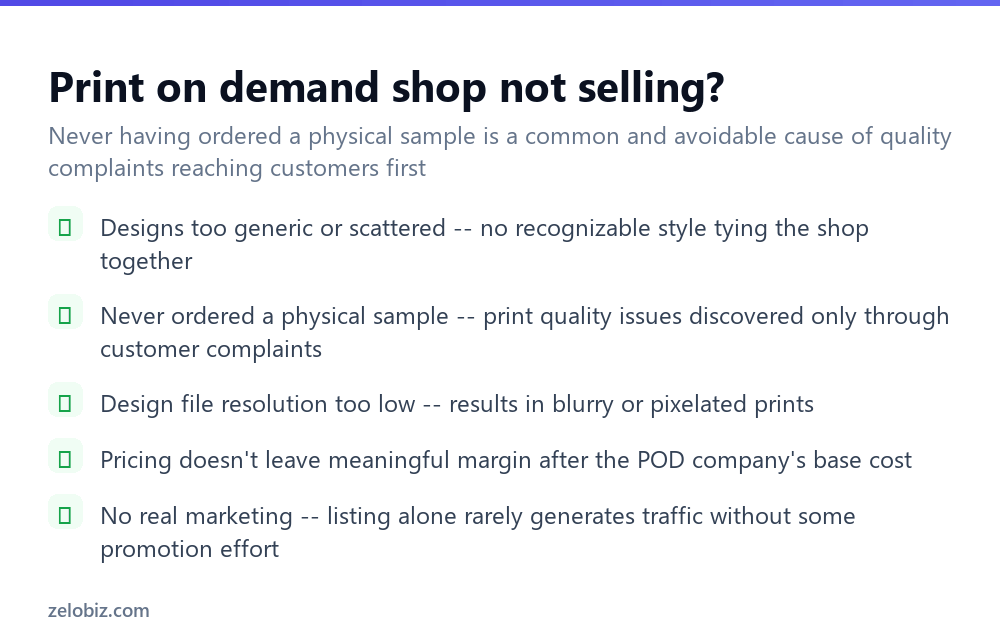
Designs too generic or scattered — no recognizable style tying the shop’s offerings together into something a buyer would want to browse further.
Never ordered a physical sample — print quality issues are discovered only through customer complaints rather than caught and addressed beforehand.
Design resolution too low for the product — resulting in a blurry or pixelated actual print despite looking fine in a small on-screen preview.
No real marketing effort — a listing sitting passively rarely generates meaningful traffic without some active promotion beyond simply existing on a platform.
- ✓Order a real physical sample before listing any product publicly
- ✓Choose a recognizable design niche rather than scattered, unrelated designs
- ✓Check resolution requirements for each specific product before finalizing artwork
- ✓Compare base costs across providers for your specific planned products
- ✓Plan some active marketing effort beyond just listing products passively
- ✕Listing a product before ever seeing or testing a physical printed sample
- ✕Using a low-resolution design file that looks fine on screen but prints blurry
- ✕Assuming a well-designed listing will generate traffic with no promotion at all
- ✕Ignoring trademark or copyright issues in fan-art-style designs
- ✕Choosing a provider on price alone without checking real print quality first
Frequently asked questions
How do I start a print on demand business?
Choose a design niche, pick a POD provider and order samples to test quality, create properly sized designs for each product, and list them with genuine descriptions.
How much money do I need to start print on demand?
Very little upfront — there’s no inventory to buy in bulk. The main cost is ordering sample products to test quality before listing publicly.
What’s the difference between print on demand and dropshipping?
Print on demand products are unique to your own designs, giving genuine differentiation. Dropshipping typically resells the same products other sellers can also access.
Why does my print on demand design look blurry when printed?
The source design file’s resolution was likely too low for the product’s actual print size. Check each provider’s specific resolution requirements before finalizing artwork.
How do I choose a print on demand provider?
Order a physical sample to check print quality firsthand, and compare base costs and shipping coverage across providers for your specific planned products.
Can I use fan art or trademarked designs for print on demand?
Generally no. POD platforms enforce trademark and copyright policies, and infringing designs risk listing removal or account suspension.
- →Compare against reselling existing products: how to start dropshipping
- →A platform with a built-in handmade audience: how to sell on Etsy
- →A larger marketplace to also list on: how to sell on Amazon
- →Other realistic ways to earn online: how to make money online