
To start dropshipping, set up an online store, choose a specific niche rather than a general store, and partner with a supplier who ships products directly to your customers — you never hold inventory yourself. Your margin is the gap between your listed price and the supplier’s cost, minus advertising and platform fees. The real challenge isn’t the setup, which is genuinely low-barrier — it’s that anyone else can access the same suppliers, so sustainable margin depends on real differentiation, not just reselling the same product as everyone else.
How dropshipping actually works
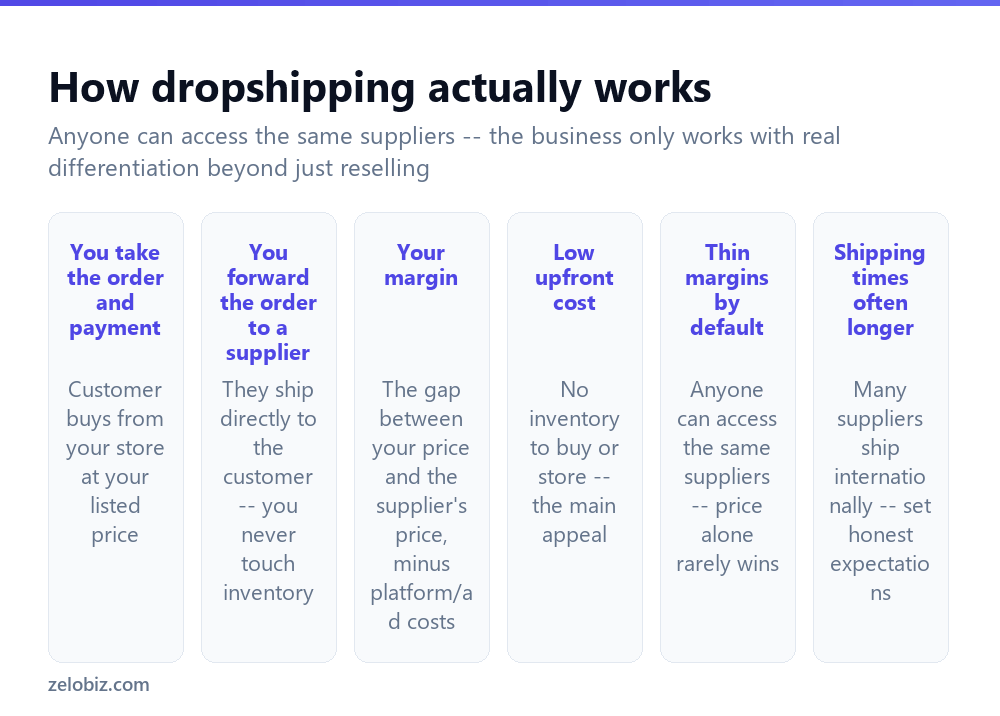
A customer buys from your online store at your listed price. You forward that order (and the wholesale cost) to a supplier, who ships the product directly to your customer — you never physically handle or store the inventory yourself at any point.
Your margin is the gap between what the customer paid you and what you paid the supplier, minus advertising costs, platform fees, and payment processing fees. This is genuinely the appeal of the model — no upfront inventory investment, no storage, no shipping logistics to manage personally.
It’s also the model’s core constraint: because the barrier to setting up a dropshipping store is low, and the same supplier catalogs are broadly accessible to anyone, margins are thin by default unless something beyond simple reselling differentiates your store from the many others that could list the identical product.
Price competition alone rarely works in dropshipping, because a competitor accessing the same supplier at the same wholesale cost can always undercut a price-only strategy. Real, sustainable dropshipping businesses usually win on niche focus, brand, customer experience, or genuinely better product curation — not on being marginally cheaper.
Setting up a store
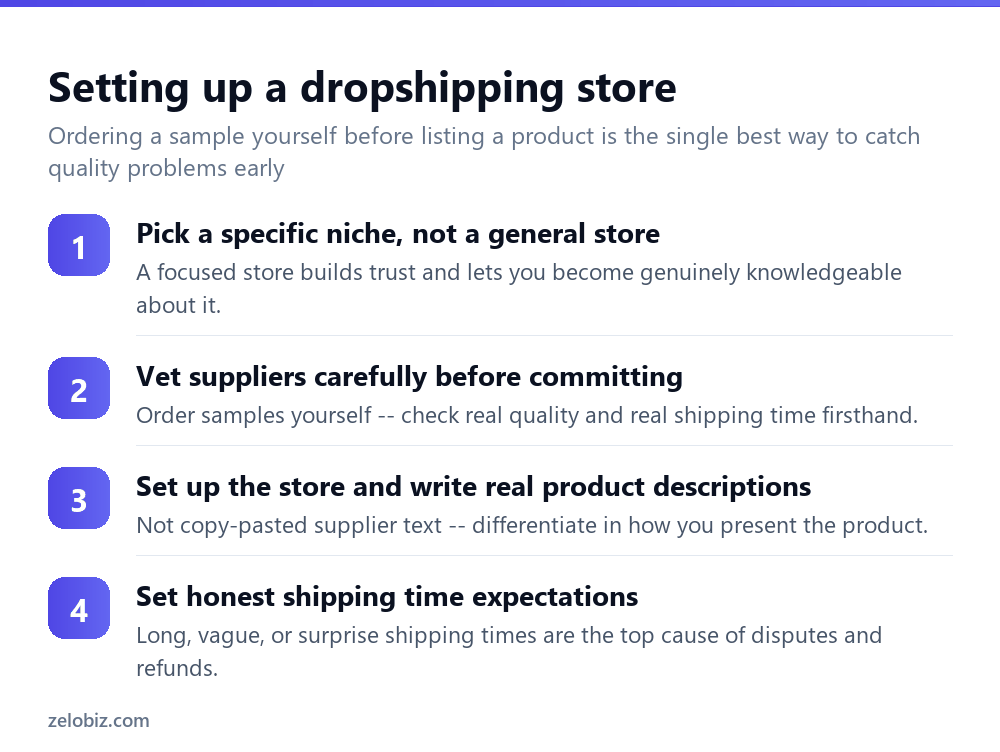
Pick a specific niche, not a broad general store selling everything. A focused store around a real category builds more buyer trust, lets you genuinely learn the products and their customers, and makes marketing far more targeted and effective than a generic “everything store” ever manages.
Vet suppliers carefully before committing to listing their products — order a sample of the actual item yourself, checking real build quality and genuine shipping time firsthand, rather than trusting supplier-provided photos and claimed shipping estimates alone.
Write real product descriptions, not copy-pasted supplier text. This is one of the more achievable ways to actually differentiate a store from others listing the identical product — through genuinely useful, specific description content rather than boilerplate.
Set honest shipping expectations from the start — covered in more detail below, since unrealistic shipping promises are one of the most common sources of customer disputes in this specific business model.
Where real differentiation comes from
Since price alone rarely sustains margin, the businesses that actually work long-term in this model differentiate somewhere else. Niche depth — becoming the genuinely best, most trusted source for one specific category rather than a generic reseller of anything. Curation — selecting genuinely better products within a category rather than listing everything a supplier offers indiscriminately. Brand and customer experience — fast, responsive customer service and a store that feels trustworthy and professional, not generic and interchangeable.
None of these are unique to dropshipping specifically — they’re just what genuinely differentiates any retail business from its competitors. Dropshipping’s low barrier to entry makes them matter more, not less, since the underlying products themselves usually can’t be the differentiator.
Setting honest shipping expectations
Many dropshipping suppliers, particularly those sourcing internationally, have genuinely longer shipping times than customers accustomed to next-day retail delivery expect by default. Setting this expectation clearly and upfront on the product page and at checkout — rather than a customer discovering it only after ordering — is the single most effective way to prevent disputes and refund requests stemming from shipping delays.
A customer who knew upfront that an item would take two to three weeks rarely disputes it arriving in that window. A customer who expected standard fast shipping and wasn’t told otherwise frequently does, even for the exact same actual delivery time.
Testing before scaling
Start with a small number of well-vetted products rather than listing a supplier’s entire catalog at once. This makes it practical to genuinely test real demand, verify actual supplier reliability over several real orders, and confirm the margin holds up once real advertising costs (not just the product cost) are factored in, before committing more significant time and marketing budget to scaling up.
A worked example: launching a niche dropshipping store
Say you’re launching a store focused specifically on gear for people who camp with dogs — a genuine niche within the broader outdoor and pet categories.
Before listing anything, order samples of the three or four products you’re most excited about — a collapsible dog water bowl, a dog-specific sleeping pad, a portable waste-bag dispenser — checking real material quality and actual delivery time from your chosen supplier. If any sample disappoints on arrival, that’s information to act on before a paying customer discovers the same problem.
Write product descriptions from genuine knowledge of camping with a dog specifically — what actually matters when choosing a dog sleeping pad for cold ground, how a collapsible bowl needs to balance packability against being tip-resistant on uneven terrain — rather than restating generic supplier bullet points a dozen other stores are using verbatim for the identical product.
State shipping time clearly on every product page, and consider whether the niche focus itself supports content marketing (a blog post on “what to pack for camping with a dog,” linking to relevant products) that a generic multi-category store couldn’t credibly produce — this is exactly the kind of differentiation that a focused niche makes possible and a broad, unfocused store cannot easily replicate.
Payment processing and return handling
Since you never hold the physical product, returns work differently than traditional retail — a return typically needs to go back to the supplier, not to you directly, and return policies (who pays return shipping, whether the supplier accepts returns at all for a given product) vary meaningfully between suppliers. Confirming a supplier’s actual return process before committing to sell their product avoids an unpleasant surprise the first time a customer requests one.
It’s worth building your own store’s stated return policy around what your specific supplier can actually support, rather than promising something generically customer-friendly that the supplier behind the scenes won’t actually accommodate when a real return request comes in.
Why dropshipping stores commonly fail
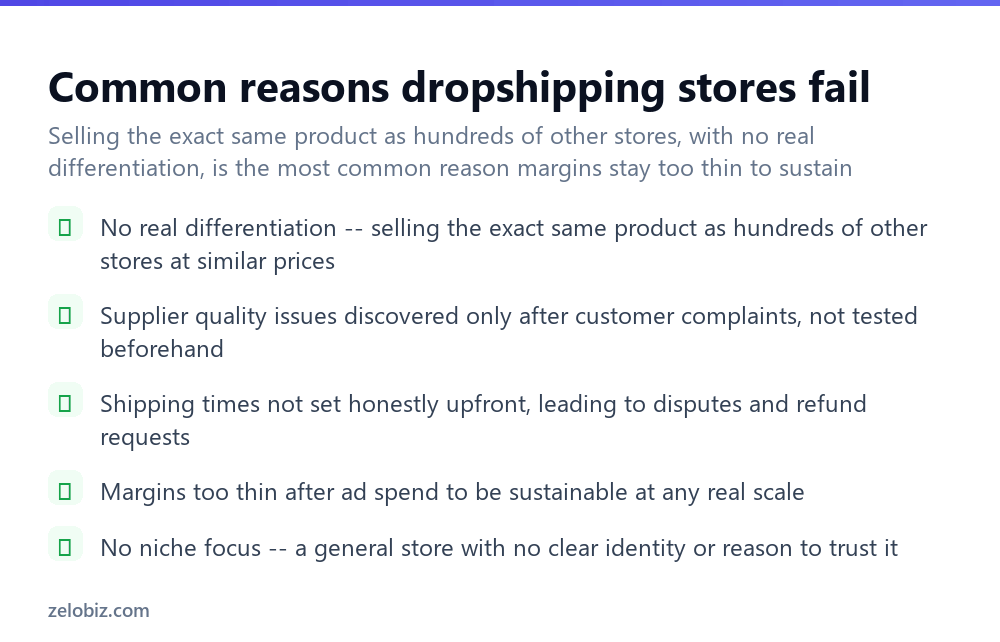
No real differentiation — selling the exact same product as hundreds of other stores at a similar price, with nothing else distinguishing the store, is the most common single reason margins stay too thin to sustain.
Supplier quality issues discovered too late — only after customer complaints, rather than caught earlier through a personally ordered sample before ever listing the product.
Shipping times not set honestly — leading directly to disputes and refund requests that erode already-thin margins further.
Margins too thin after real ad spend to sustain the business at any meaningful scale, once genuine customer acquisition cost is factored in alongside product cost.
A quick reference
Considering a broad general store vs a focused niche: choose the niche — it supports real differentiation and content marketing a general store can’t credibly manage. Margin looks thin after ad spend: revisit whether the product and niche genuinely support a price premium, rather than trying to out-discount competitors accessing the same supplier. First disputes arriving: check whether shipping time was stated clearly on the product page before assuming it’s a supplier quality problem.
- ✓Choose a specific niche rather than a broad, generic store
- ✓Order a real sample from any supplier before listing their product
- ✓Write genuine product descriptions instead of copy-pasted supplier text
- ✓Set shipping time expectations clearly and upfront, before checkout
- ✓Test with a small product range before committing to scaling up
- ✕Competing on price alone against others accessing the same supplier
- ✕Listing a supplier’s product without personally verifying its actual quality first
- ✕Copy-pasting supplier descriptions with no genuine differentiation
- ✕Leaving shipping time vague or discovered only after a customer orders
- ✕Listing a supplier’s entire catalog at once before testing real demand and margin
Frequently asked questions
How do I start a dropshipping business?
Set up an online store, choose a specific niche, carefully vet suppliers by ordering samples yourself, and set honest shipping time expectations before listing products.
Is dropshipping still profitable?
It can be, but margins are thin by default since suppliers are broadly accessible to anyone. Sustainable profitability usually requires real differentiation — niche focus, curation, or brand — not just reselling at a marginally lower price.
Do I need to hold inventory to start dropshipping?
No. The supplier ships directly to your customer — you never physically handle or store the product yourself.
Why do dropshipping stores commonly fail?
Most often: no real differentiation from competing stores selling the identical product, supplier quality issues, dishonest or unclear shipping expectations, and margins too thin after real advertising costs.
How do I choose a good dropshipping supplier?
Order a sample of the actual product yourself first, checking real quality and genuine shipping time, rather than trusting supplier photos and claimed estimates alone.
Why is shipping time such a big issue in dropshipping?
Many suppliers ship internationally with longer timeframes than typical retail delivery. Setting this expectation clearly upfront prevents most disputes stemming from it.
- →A lower-risk alternative with less competition: how to start a print on demand business
- →Sell products without a full store build: how to sell on Etsy
- →A larger built-in marketplace audience: how to sell on Amazon
- →Build the store foundation first: how to make a website