
Affiliate disclosure: This post contains an affiliate link. If you buy through it, Zelobiz may earn a commission at no extra cost to you. That doesn’t change what we say below.
ProjectBloom is a brand asset management platform aimed specifically at agencies juggling several different client brands at the same time, built around centralized brand kits and an AI content assistant called Agent Bloom that drafts copy in each client’s own voice. It sold as an AppSumo lifetime deal in 2025, and we checked back in 2026 to confirm whether it’s still buyable, what it costs, and what the smaller but real body of user feedback says about it.
What ProjectBloom actually does
ProjectBloom centralizes everything an agency needs to keep a brand consistent: logos, color palettes, fonts, and tone-of-voice guidelines all live in one brand kit per client, instead of scattered across shared drives, Slack messages, and whichever team member happened to save the latest logo file last. Agent Bloom, the platform’s AI assistant, is trained on each specific brand kit and is meant to generate on-brand content quickly, drafting social captions or short copy that already matches a client’s established voice rather than starting from a blank page every time.
Beyond the AI layer, the platform includes a content calendar for scheduling and visualizing campaigns across brands, flexible user roles and permissions so team members only see the brands and projects relevant to them, and Google Drive integration for pulling existing assets into the system rather than re-uploading everything from scratch.
The underlying problem ProjectBloom targets is a familiar one to anyone who’s worked agency-side. A client’s brand guidelines live in a PDF someone made two years ago, half the team is using the old logo because nobody updated the shared folder, and a new freelancer’s first week is spent hunting down basic brand assets instead of doing billable work. That’s not a hypothetical, it’s close to the default state for a lot of small and mid-size agencies without a dedicated brand operations person, and it’s the exact gap this category of software, ProjectBloom included, is trying to close. Whether a given tool actually closes that gap for a specific agency’s workflow, rather than just moving the same disorganization into a new, paid piece of software, is the real question a buyer needs answered before committing to any option in this category, ProjectBloom or otherwise.
Is the AppSumo deal still available?
No. ProjectBloom shows “Sold out” on AppSumo, with the standard “This deal is unavailable” message in place of a purchase button. There’s no live purchase path, only a notification signup for a possible restock.
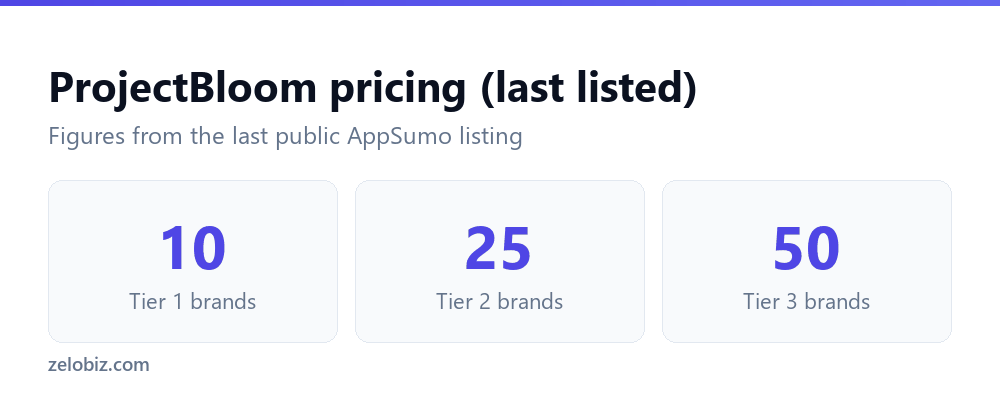
The deal sold across tiers scaled by workstation and brand count:
| Tier | Workstations | Brands | Users | Storage | GPT tokens/month |
|---|---|---|---|---|---|
| Solo | 10 | 10 | 5 | 10 GB | 200,000 |
| Standard | 25 | 25 | 10 | 20 GB | 500,000 |
| Teams | 50 | 50 | 35 | 50 GB | 1,000,000 |
All tiers carried the standard 60-day AppSumo money-back guarantee and were restricted to new ProjectBloom users only, a common condition on AppSumo deals meant to prevent existing paying subscription customers from downgrading their ongoing costs to a one-time lifetime price instead.
Setting it up in practice
Getting started means building your first brand kit: uploading logos and brand colors, defining fonts, and writing out tone-of-voice guidelines that Agent Bloom will reference when generating content later. That upfront investment is the part that determines how useful the AI assistant ends up being. A thin, generic brand kit tends to produce thin, generic AI output in return, while a more detailed one with real, concrete examples of the brand’s actual voice gives Agent Bloom substantially more to work from when drafting anything. Agencies migrating several existing client brands into the system at once should expect that setup phase to take real time per brand, not a five-minute import.
It’s worth budgeting that setup time honestly before purchase rather than assuming the AI assistant will compensate for a rushed brand kit. Reviewers who described genuinely useful output from Agent Bloom had generally put real effort into the underlying brand documentation first, writing out actual tone guidelines and providing sample copy rather than filling in the bare minimum required fields and expecting the AI to infer the rest from a logo and a color palette alone.
Once the initial brand kits are built and populated, day-to-day use shifts to center mostly on the content calendar and on Agent Bloom’s ongoing drafting assistance, which is where the platform is meant to start paying back the time invested during that earlier setup phase, ideally on a weekly or even daily basis as new content needs come up across the agency’s full client roster. Assigning team members to specific brands through the role and permission system keeps a freelancer or junior team member from accidentally editing a different client’s assets, which matters more as an agency’s roster of managed brands grows past a handful.
Client turnover, agencies inevitably gain and lose accounts over time, is worth planning for too and a brand management system needs to handle offboarding as cleanly as onboarding. Removing a departed client’s access and archiving or deleting their brand kit without disrupting the workstation counts of active brands is the kind of housekeeping task that matters more once an agency has been using the platform for a year or two than it does on day one, when everything still feels new and the client roster is small and stable.
Key features
The distinction between ProjectBloom and a generic AI writing tool is that Agent Bloom is scoped to a specific brand kit rather than producing generic output you then have to edit into shape. That’s a meaningful difference for an agency managing multiple clients with noticeably different voices, a playful DTC brand and a formal B2B client shouldn’t sound the same coming out of the same AI assistant, and brand-kit scoping is the mechanism meant to prevent that.
The content calendar gives a visual, cross-brand view of what’s scheduled where, useful for an agency account manager juggling several clients’ posting schedules simultaneously rather than checking each client’s calendar separately. Google Drive integration reduces duplicate asset storage, letting existing files stay where they already live rather than forcing a full migration into ProjectBloom’s own storage before the platform becomes useful.
How it compares to the alternatives
| Tool | Pricing model | Best for |
|---|---|---|
| ProjectBloom | One-time payment (when available) | Smaller agencies wanting brand kits plus AI drafting |
| Frontify | Monthly/annual subscription, enterprise-tiered | Larger organizations with formal brand governance needs |
| Bynder | Enterprise subscription | Large-scale digital asset management |
| Canva Brand Kit | Included in Canva subscription | Simple brand consistency inside an existing design tool |
Frontify and Bynder are the established players in brand asset management, both built for larger organizations with dedicated brand teams and correspondingly enterprise-level pricing that a small agency would find hard to justify. Canva’s built-in Brand Kit feature is the lightweight, low-cost alternative on the other end, folding basic brand consistency into a tool many agencies already pay for, though it lacks ProjectBloom’s dedicated AI drafting assistant and its dedicated multi-brand workstation structure built specifically around agencies rather than single-brand design teams. ProjectBloom’s lifetime pricing aimed to sit in the gap between those two extremes: more structured than Canva’s brand kit, more affordable than an enterprise DAM platform. That gap is a real one in the market: plenty of small agencies have outgrown a folder of shared logo files but have no realistic path to an enterprise DAM budget, and it’s that specific segment ProjectBloom’s lifetime pricing was aimed at capturing before it sold out.
What users say
ProjectBloom’s AppSumo rating sits at 4.00 out of 5, but from a notably small sample of just 6 verified reviews, meaningfully thinner evidence than most of the other tools in this batch. The reviews that exist describe the platform as a real time-saver for simplifying marketing workflows and improving brand consistency across managed clients, with specific praise for the centralized brand asset location and the AI content assistance. With a sample this small, it’s worth treating the rating as a preliminary signal rather than a settled verdict. A handful of positive reviews tells you the early adopters were satisfied; it doesn’t tell you much about how the product holds up at scale or under less favorable conditions the way a rating built from dozens or hundreds of reviews would.
Pros
- Centralizes brand assets across multiple clients in one system
- AI assistant (Agent Bloom) is scoped per brand kit rather than generic
- Content calendar gives cross-brand visibility for agency account managers
- Role-based permissions suit teams managing several client brands at once
- One-time payment undercut enterprise DAM platforms like Frontify or Bynder
Cons
- Currently sold out, with no confirmed restock date
- AppSumo review sample is small (6 reviews), a thinner evidence base than most competitors
- Deal was restricted to new users, excluding existing ProjectBloom customers
- Quality of AI output depends heavily on how thorough the initial brand kit setup is
- Was English-only at launch, with additional languages planned but not yet confirmed delivered
Who it’s for
ProjectBloom made the most sense for a small-to-mid-size agency managing somewhere between a handful and a few dozen client brands, wanting a middle-ground option between an enterprise DAM platform they can’t justify and an ad hoc system of shared drives and Slack messages that gets messier as the client roster grows. It was a weaker fit for a single-brand business with no multi-client management need, since the workstation and multi-brand structure is specifically built around agency use cases rather than in-house marketing teams managing just one brand. An in-house marketer at a single company would likely find a simpler brand kit tool, or even a well-organized shared drive with clear naming conventions, sufficient for their needs without paying for capacity built around managing dozens of separate client relationships.
Verdict: is ProjectBloom worth it?
With the deal sold out and the review evidence still thin, this is a harder call than some of the other tools in this batch. The concept and feature set are sound, brand-scoped AI assistance addresses a real and common agency pain point, but a 6-review sample isn’t enough to confidently predict how the product performs at scale, or over a longer stretch of daily use across a growing roster of managed brands and changing team members. If the deal returns, it’s worth trying inside the 60-day refund window specifically to test Agent Bloom’s output quality against your own brand kits before committing to a higher tier, rather than assuming the small positive sample generalizes to your specific use case. Run that test with the client brand whose voice is hardest to nail, not the easiest one, since that’s the scenario most likely to expose the limits of an AI assistant working from a brand kit rather than years of institutional familiarity with a specific client’s tone.
Frequently asked questions
How does ProjectBloom handle client offboarding?
The role and permission system supports removing a departed client’s access and archiving their brand kit, which matters more once an agency has used the platform for a year or two and its client roster has changed.
Is ProjectBloom still available on AppSumo?
No, it’s currently marked sold out, with only a notification signup in place of a purchase option.
How reliable is ProjectBloom’s AppSumo rating?
The 4.00/5 rating is based on only 6 verified reviews, a small sample that should be treated as an early, preliminary signal rather than a definitive verdict.
Does the quality of Agent Bloom’s output depend on setup effort?
Yes. A detailed, well-documented brand kit produces more accurate, on-brand AI output than a thin one with minimal guidance entered.
Was ProjectBloom available to existing customers at the AppSumo price?
No, the lifetime deal was restricted to new ProjectBloom users only, a standard AppSumo condition meant to prevent existing subscribers from downgrading.
What’s a lighter-weight alternative for basic brand consistency?
Canva’s built-in Brand Kit feature offers simple brand consistency for teams already using Canva, though without ProjectBloom’s dedicated AI drafting assistant or multi-brand workstation structure.
Check the live status of the deal on AppSumo’s ProjectBloom page before assuming availability has changed.