
There’s no single way to make money online — the real question is which approach fits your situation. Freelancing an existing skill (writing, design, admin support) pays fastest, often within days. Selling products on eBay, Etsy, or Amazon takes longer to set up but can scale further. Content — a blog or YouTube channel — takes the longest to pay off (often 6-12 months of consistent work before meaningful income) but has the highest ceiling, since it can eventually earn without trading more hours for more money. Match the method to how quickly you actually need income, not just which sounds most appealing.
Speed to first dollar vs long-term ceiling
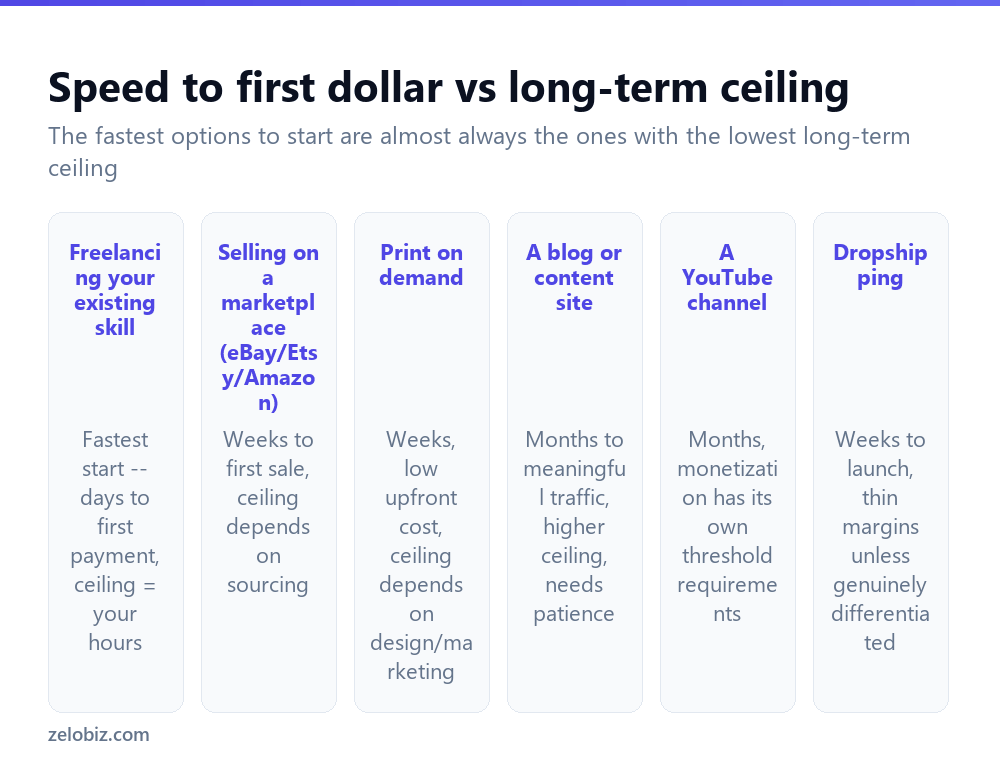
This tradeoff is the single most useful lens for deciding where to start, and it’s the thing most “make money online” content skips over in favor of just listing options.
Freelancing an existing skill — writing, design, virtual assistance, bookkeeping, whatever you already know how to do — is the fastest realistic path to actual money, sometimes within the first week on a freelance platform. Its ceiling is your available hours; income scales only by charging more per hour or working more of them, both of which run into real limits.
Selling products — on eBay, Etsy, or Amazon — takes longer to set up (sourcing or making inventory, setting up a listing, waiting for the first sale) but isn’t capped by your personal hours in the same direct way once a listing exists and can sell repeatedly.
Content — a blog, a YouTube channel — is the slowest to pay off by a wide margin. Meaningful traffic and monetization typically take months of consistent work, and many attempts never reach it. But content that does succeed can keep earning long after it was created, with no direct trade of additional hours for additional income, which is the genuinely different economic shape from freelancing.
If you need money this month, freelancing or selling something you already own beats starting a blog. If you’re building toward something that eventually runs with less of your ongoing time, content or a real product business is the more honest long-term bet — but budget realistic months, not days, before it pays meaningfully.
Freelancing an existing skill
The fastest starting point for most people, because it doesn’t require building anything new — it monetizes a skill you already have. Writing, graphic design, virtual assistance, bookkeeping, social media management, and translation are all in consistent demand on freelance platforms.
Realistic expectations matter here: the first few jobs on a new freelance profile typically pay below what the work is actually worth, since you’re building a review history with no track record yet. Treat early low-paying jobs as earning credibility rather than the long-term rate, and raise prices once a handful of solid reviews exist.
Selling on a marketplace
eBay, Etsy, and Amazon each suit different kinds of selling — eBay for used or collectible items and a wide general audience, Etsy for handmade or craft-style products, Amazon for scaled retail with the largest built-in customer base but the most competition and fees. Each is covered in more depth in its own guide linked below.
The realistic first step for many people is simply selling things they already own and no longer need — genuinely the fastest way to see a real sale land, and useful for learning the mechanics of a platform’s listing and shipping process before investing in sourced or made inventory.
Print on demand and dropshipping
Both let you sell physical products without holding inventory yourself — a third-party manufactures or ships each order as it comes in. The appeal is low upfront cost; the real constraint is that margins are thin unless the product or design is genuinely differentiated, since anyone can access the same suppliers and templates. Success in this space tends to come from strong, specific design or niche targeting, not from the business model itself being a shortcut.
Building a blog or content site
The slowest path to first income, and the one most often abandoned before it pays off, precisely because the payoff is genuinely months out rather than weeks. It monetizes through a combination of display ads, affiliate links, and sometimes selling a product or service to the audience it builds.
What separates a blog that eventually earns from one that doesn’t is usually consistency and a real content strategy targeting actual search demand, not motivation or writing talent alone — see the SERP-focused approach covered across this site’s other guides for what that looks like in practice.
Starting a YouTube channel
Similar economics to blogging — a real time investment before monetization, plus specific eligibility thresholds (subscriber count and watch hours) that must be met before ad revenue is even possible at all, regardless of content quality before that point. Many successful channels also earn through sponsorships and affiliate links well before or instead of relying on ad revenue specifically.
A realistic first 90 days
Regardless of which method you pick, a rough shape holds across most of them: the first few weeks involve more setup and learning than actual income, and it’s normal for early results to look unimpressive compared to what success stories tend to show once they’re already established.
For freelancing, that might mean your first two or three jobs pay modestly while you build reviews. For a marketplace listing, it might mean the first several items sell slowly while you learn what photos and descriptions actually convert browsers into buyers. For content, ninety days is genuinely still early — expect groundwork, not income, and treat that as the normal, expected shape of the work rather than a sign it isn’t working.
The people who stick with a chosen method through this unglamorous early period, adjusting based on what the actual results show rather than switching methods entirely at the first sign of slowness, are generally the ones who eventually see it pay off.
Red flags worth taking seriously
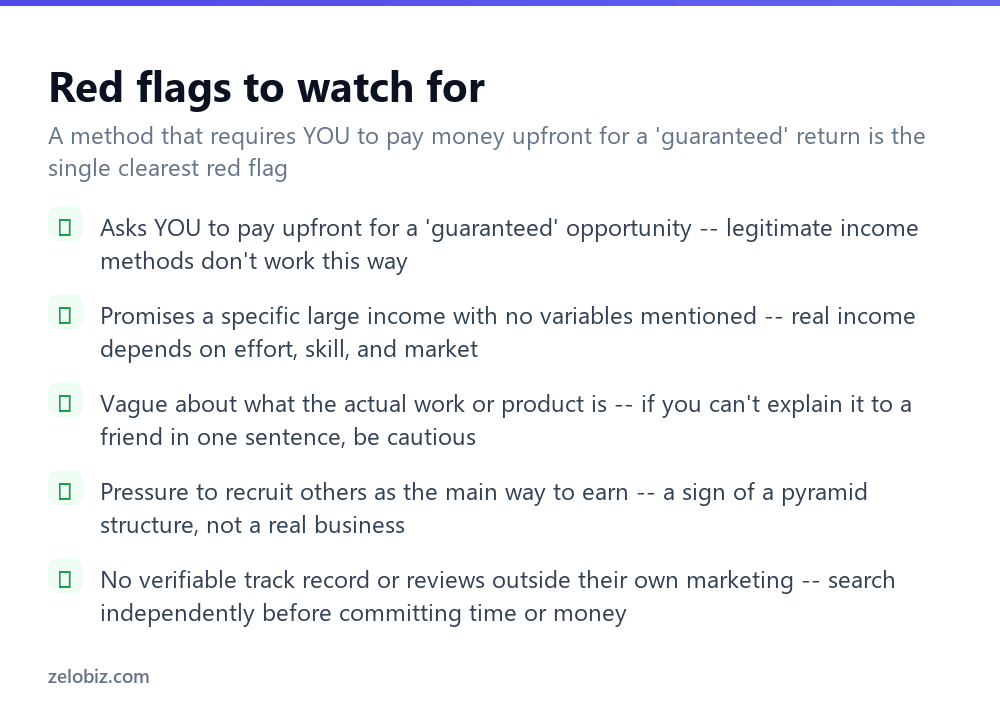
Anything asking you to pay money upfront for a ‘guaranteed’ income opportunity is the single clearest red flag. Legitimate freelancing, selling, and content work don’t require paying someone else first to access them.
A specific large income promise with no mentioned variables — “make $5,000 a month guaranteed” — ignores that real income from any of these methods depends heavily on effort, existing skill, market conditions, and time invested. Genuine opportunities describe a range and the factors that affect it, not a flat guarantee.
Vagueness about what the actual work or product is — if an opportunity can’t be explained in one clear sentence (“I write blog posts for clients” vs. some unclear description of “the system”), be cautious about what’s actually being sold.
Pressure to recruit others as the primary way to earn, rather than from a product or service itself, is a structural sign of a pyramid scheme rather than a real business, regardless of how it’s marketed.
- ✓Match the method to how fast you actually need income, not just appeal
- ✓Treat early low-paying freelance jobs as building credibility, not the long-term rate
- ✓Budget realistic months, not days, before content-based income becomes meaningful
- ✓Research any opportunity independently before paying anything upfront
- ✓Pick one path and commit to a real trial period rather than spreading thin across several
- ✕Expecting a blog or YouTube channel to pay off within weeks
- ✕Paying money upfront for a ‘guaranteed’ income opportunity
- ✕Trusting a specific income promise with no mentioned variables or range
- ✕Chasing five different income methods at once with shallow effort in each
- ✕Ignoring pressure to recruit others as the main way an opportunity claims you’ll earn
Frequently asked questions
What is the fastest way to make money online?
Freelancing an existing skill on a platform, or selling items you already own on a marketplace, both typically pay within days to weeks — much faster than content-based income.
What online income method has the highest long-term potential?
Content (a blog or YouTube channel) and building a real product business both have higher ceilings than freelancing, since they aren’t capped by trading your personal hours directly for money, but both take significantly longer to pay off.
How long does it take to make money from a blog?
Typically 6-12 months of consistent, strategy-driven work before meaningful traffic and income, and many attempts never reach that point.
Is dropshipping still a good way to make money online?
It can work, but margins are thin unless the product or niche is genuinely differentiated, since the underlying suppliers and business model are accessible to anyone.
How can I tell if an online income opportunity is a scam?
Watch for upfront payment requirements, guaranteed income promises with no mentioned variables, vague descriptions of the actual work, and pressure to recruit others as the main way to earn.
Should I try several online income methods at once?
Generally no. Committing to one method for a real trial period produces better results than spreading shallow effort across several simultaneously.
- →Build the foundation for a content or product business: how to make a website
- →The slower, higher-ceiling content path: how to start a blog
- →Sell what you already own first: how to sell on eBay
- →A lower-cost way to sell physical products: how to start a print on demand business