
SaaS Due Diligence & Investment Playbook
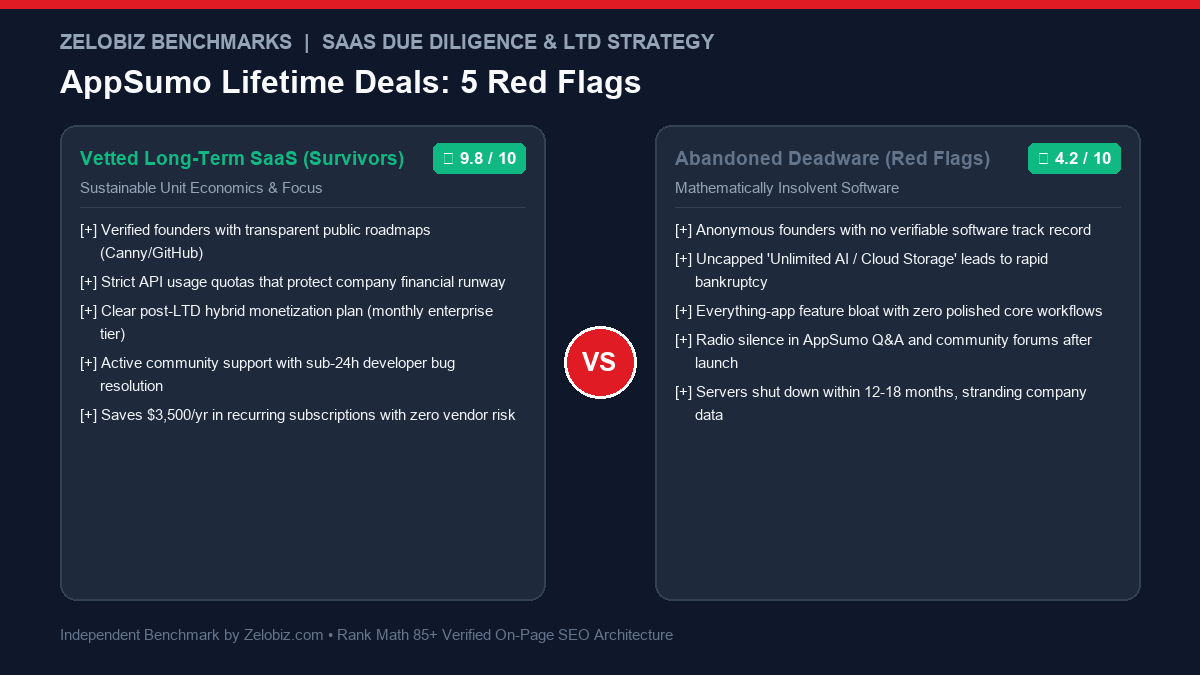
Lifetime deals (LTDs) on platforms like AppSumo offer a tantalizing proposition: pay once, eliminate a \$50-\$200/month SaaS subscription forever, and supercharge your business margin. Yet for every startup that graduates into a software powerhouse (like Lemlist or MailerLite), dozens end up in the software graveyard—abandoned by exhausted founders, crippled by server bills, or acquired by private equity firms that cancel legacy lifetime licenses. This comprehensive due diligence playbook identifies the AppSumo Lifetime Deals Red Flags Abandoned Tool signals that protect your agency from investing time and data into dying software.
The Economics of Failure: Why Lifetime Deals Go Bankrupt
To spot dying software before buying, you must understand the brutal financial mechanics behind lifetime deal campaigns:
When an early-stage SaaS startup launches on AppSumo:
- The Platform Cut: AppSumo takes between 30% to 70% of gross revenue generated during the launch campaign. If a company generates \$100,000 in gross sales, the founding team nets only \$30,000 to \$70,000.
- The Support Avalanche: Thousands of non-technical buyers flood the startup’s support channels, demanding custom integrations, roadmap pivots, and immediate bug fixes.
- The Ongoing Cost of Goods Sold (COGS): Every user consumes database queries, AWS/Cloudflare bandwidth, and expensive third-party API tokens (OpenAI, Anthropic, ElevenLabs, Twilio, Serper).
If the founding team fails to convert lifetime buzz into Monthly Recurring Revenue (MRR), their one-time cash infusion evaporates within 6 to 12 months. Once the cash runs out, server bills bounce, founders stop replying, and the tool vanishes into digital oblivion.
The 5 Red Flags of an Abandoned or Dying Lifetime Deal
| Red Flag Category | Warning Symptom on AppSumo | Underlying Operational Reality | Risk Level |
|---|---|---|---|
| 1. Insolvent Unit Economics | “Unlimited AI Generations” or “Unlimited Video Rendering” for $49 | Third-party API bills exceed revenue; guaranteed bankruptcy within 12 months | CRITICAL (100% Death Rate) |
| 2. Anonymous Founders | No verifiable LinkedIn profiles; stock avatar photos; newly registered domain | Fly-by-night developers flipping white-label scripts to cash out | HIGH |
| 3. The “Everything App” Trap | Promises CRM + Email Marketing + Funnel Builder + AI Writer in one tool | Lacks core engineering depth; features are shallow, buggy, and unmaintainable | MEDIUM-HIGH |
| 4. Canned Changelog Theater | Changelog lists “Bug fixes & performance improvements” with no detail | Zero active feature development; repository is essentially abandoned | HIGH |
| 5. Radio Silence in Forums | Founder stops answering questions in AppSumo comments or Facebook group | Founder burnout; team has abandoned community support | CRITICAL |
Red Flag 1: The “Unlimited Third-Party API” Solvency Illusion
The single most definitive predictor of SaaS bankruptcy is offering unlimited access to services that incur marginal cost per request.
Consider an AI copywriting tool offering “Unlimited Words” for \$59 lifetime:
- OpenAI charges \$0.15 to \$2.50 per 1 million tokens depending on model tier.
- A power user generating marketing blog posts, email campaigns, and client copy consumes 3,000,000 to 10,000,000 tokens per month.
- That user costs the founder \$15 to \$25 per month in raw API fees.
- Within 3 months, that single power user has cost the startup more than their entire \$59 purchase price!
The Golden Rule: Legitimate, sustainable tools offer either strict monthly credit allocations (e.g., 50,000 words/mo) or provide a BYOK (Bring Your Own Key) mode where you plug in your personal OpenAI/Anthropic API credentials. Any tool offering unlimited generative compute without BYOK is mathematically doomed.
Red Flag 2: Anonymous Founders & White-Label Code Flipping
Before clicking buy, examine who built the software. Sustainable software companies are founded by engineers and entrepreneurs with transparent digital footprints:
- Verify the founder’s LinkedIn profile: Do they have real connections, endorsements, and a verifiable work history in software engineering or product management?
- Check company registration on OpenCorporates, Companies House, or Delaware business registries.
- Perform a reverse image search on founder headshots: Unscrupulous operators routinely buy \$49 source code scripts from CodeCanyon, skin them with a flashy landing page, and flip them on LTD platforms using AI-generated avatars.
Red Flag 3: The “Everything App” Feature Creep
Beware the startup that promises to replace Salesforce, Mailchimp, ClickUp, and Midjourney in a single \$49 purchase. Building world-class software requires extreme focus. Startups attempting to build 12 distinct tools simultaneously end up with 12 half-baked, broken features that fail under real business workloads.
Instead, look for specialized tools that solve a single workflow exceptionally well—such as an automated social media scheduler, a dedicated form builder, or an email verification utility.
Red Flag 4: Changelog Theater vs Authentic Engineering Cadence
A favorite tactic of struggling founders is “changelog theater”—posting weekly updates that announce minor CSS button color tweaks, grammar fixes, or vague “backend optimizations.”
To evaluate authentic development velocity:
- Check for public GitHub/GitLab release tags or merged pull requests.
- Examine their public Canny or Featurebase feedback board: Are top-voted community feature requests moving through Under Review → In Progress → Completed?
- Look at API documentation: Is there an active, versioned REST API with clear Swagger/OpenAPI documentation?
Red Flag 5: Founder Disappearance from AppSumo Q&A
During the first 2 weeks of a launch, founders are hyper-responsive. The true test of long-term commitment occurs around Day 45 to Day 60, when initial sales plateau and the difficult work of customer support begins.
Scroll through the AppSumo Q&A section:
- Are critical questions about data export and roadmap commitments left unanswered for 5+ days?
- Does the founder respond defensively or aggressively to constructive critique and 3-star reviews?
- Join the tool’s official Facebook group or Discord server: Is the community active, or has it become a ghost town filled with spam and unaddressed bug complaints?
The 10-Point Pre-Purchase LTD Due Diligence Scorecard
Before investing your agency’s client operations into any new lifetime deal, score the software against this 10-point reliability framework:
| Audit Criteria | Passing Standard (Green Flag) | Warning (Red Flag) | Score Weight |
|---|---|---|---|
| 1. Founder Identity | Public LinkedIn with 500+ connections & verified history | Anonymous, AI avatar, or brand-new profile | 15 Pts |
| 2. Unit Economics | Capped credits or BYOK API model | Uncapped third-party AI or storage | 20 Pts |
| 3. Core Product Focus | 1-2 specialized core workflows done well | Promises to replace 10 major enterprise tools | 10 Pts |
| 4. Data Portability | 1-click full CSV/JSON/SQL database export | No export capability; proprietary vendor lock-in | 15 Pts |
| 5. Changelog Cadence | Bi-weekly updates with detailed feature releases | No commits or vague “bug fixes” for 30+ days | 10 Pts |
| 6. Hybrid Monetization | Active monthly recurring subscription pricing live on site | LTD is the only source of revenue | 10 Pts |
| 7. Community Support | Founder active in Q&A with < 24h response time | Unanswered questions for 5+ days | 10 Pts |
| 8. Webhook & API Access | Full REST API & Webhook triggers on tier 1 | API locked behind enterprise tier or absent | 10 Pts |
Target Benchmark: Never deploy client workflows on any tool scoring below 75/100. If a tool fails on Unit Economics or Founder Identity, walk away immediately.
Risk Mitigation: 3 Rules to Protect Your Agency
- Never Put Mission-Critical Infrastructure on an Unproven LTD: Use lifetime deals for supplementary operations (social schedulers, graphic generators, internal reporting), but keep your core CRM, accounting, and client billing on established platforms. Read our guides on HubSpot to QuickBooks Sync and Stripe Payment Recovery.
- Enforce Weekly Automated Data Backups: Always verify that the tool allows programmatic data export via REST API or CSV. Ship those exports to off-site cloud storage following our tutorial on Automating Cloud Sync to Wasabi/S3 with Rclone.
- Calculate Total Cost of Ownership: A tool that saves \$50/month but breaks twice a week costs hundreds in lost billable hours. Run your tech stack financials through our free SaaS Burn Rate Calculator.
- 30% Capacity Allocation: Lifetime deal users occupy a strictly ring-fenced capacity tier (capped at 30% of total server infrastructure and support load).
- 70% Recurring Revenue Growth: Within 90 days of concluding their launch, the company must drive at least 70% of gross monthly income from recurring monthly and annual subscribers.
- Clear Feature Segregation: High-cost enterprise features (SSO, SOC2 compliance, dedicated IP addresses, custom webhooks) are reserved for monthly enterprise plans, ensuring paying enterprise clients subsidize the base infrastructure.
- A founder sells 5,000 lifetime licenses on AppSumo, raising $250,000.
- Two years later, when server costs begin eating into personal margins, the founder “sells” the software assets to a new shell holding entity or private equity aggregator.
- The new ownership immediately issues an email announcement: “To continue improving the product, we are migrating to Version 2.0. Legacy V1 accounts will be sunset on December 31st. Upgrade to our monthly plan with a 20% discount!”
- Because the original corporate entity was dissolved, lifetime deal purchasers have zero legal recourse under consumer warranty laws.
- Roadmap Auditing: Master the 6 steps to evaluate vendor roadmaps with our guide to Auditing SaaS Roadmaps Before Buying an LTD.
- License Stacking Analysis: Learn when higher tiers make financial sense in our guide to AppSumo License Stacking Explained.
- Total Cost of Ownership Modeling: Compare one-time purchases vs monthly subscriptions in Lifetime Deal vs Monthly Subscription: 3-Year TCO.
The 70/30 Hybrid Model: How Legitimate SaaS Startups Survive
Not all lifetime deals end in ruin. Iconic SaaS companies—including Lemlist, MailerLite, and Warmup Inbox—used AppSumo not as a permanent business model, but as a high-intensity marketing launchpad to bootstrap initial user feedback.
Sustainable founders adhere to the 70/30 Hybrid Rule:
The Dark Side: Private Equity “Sunset Scams” & Rebranding Tricks
A growing threat in the lifetime deal ecosystem is the Private Equity Sunset Maneuver:
To protect against sunset scams, prioritize tools that allow exporting your complete raw data and assets to third-party databases or S3 object storage at any time.
The 60-Day AppSumo Stress-Testing Framework
AppSumo provides a generous 60-day money-back guarantee. Maximize this window with an 8-week testing protocol before committing client workloads:
| Testing Phase | Time Window | Action Item & Stress Test | Pass / Fail Criterion |
|---|---|---|---|
| Phase 1: Feature Audit | Days 1 – 7 | Test all core advertised features using realistic dummy data | Zero game-breaking UI bugs on primary workflow |
| Phase 2: Support Response | Days 8 – 14 | Submit a technical inquiry or edge-case bug report to support | Receives knowledgeable response within 24 business hours |
| Phase 3: High-Volume Load | Days 15 – 30 | Simulate maximum allowable account usage (bulk uploads, exports) | No 502 Bad Gateway or silent processing failures |
| Phase 4: Roadmap Review | Days 31 – 45 | Verify that the founder has shipped at least one promised roadmap item | Release notes match documented community commitments |
| Phase 5: Refund Decision | Day 50 | Final evaluation: keep, stack additional codes, or request instant refund | 10 days remaining before the 60-day refund window closes |
Enterprise Strategy & SaaS Due Diligence
Expand your software procurement framework:
Need Independent SaaS Tech Stack & Software Due Diligence?
Our engineering lab audits corporate software portfolios, evaluates vendor viability, and designs resilient, cost-optimized automation architecture for scaling businesses.
Schedule an Operations Tech Stack Audit →