
Almost every attempt to make AI writing sound human starts with advice you cannot act on. Add personality. Use your own voice. Write like you talk. None of that tells you which sentence to change.
The signals are more concrete than that. A good share of them are specific words and constructions you can find with a search box, and the rest are patterns of shape and rhythm you can learn to see in about a minute of looking.
Short answer: Run four searches first, for the em dash character, for not just and not merely, for filler openers such as it is important to note, and for a short list of overused words. Then break the rhythm by varying sentence length and cutting groups of three down to two. Then add one specific detail only you could have supplied. Then delete the closing paragraph, which is almost always generic.
The Tells Are Countable, Not Atmospheric
Text produced by a language model tends toward the most statistically likely phrasing that fits the widest range of cases. That single property explains nearly every recognisable habit, and it is why the habits are consistent enough to list.
It also explains why the writing rarely reads as wrong. It reads as generic, which is a different complaint and a harder one to act on until you know what you are looking at.
The Ones You Can Find With a Search Box
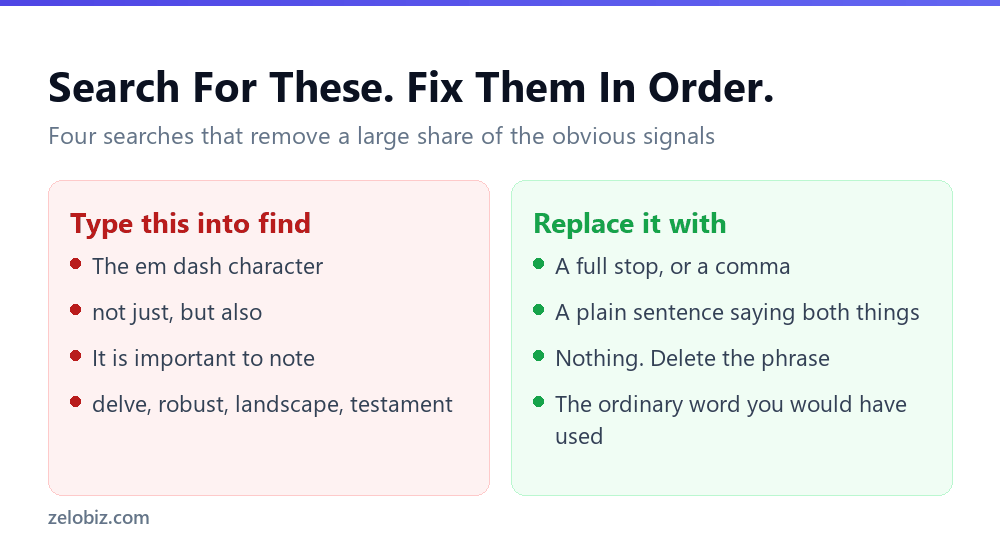
Start here because it is mechanical and it clears the noise, which makes the structural problems visible underneath.
The em dash
The single most recognisable one. Plenty of good writers use em dashes, so it proves nothing on its own, but generated text uses them at a density most people do not. Replace each one with a full stop, a comma, a colon, or brackets, whichever fits.
Negative parallelisms
It is not just about speed, it is about reliability. This construction appears constantly and says less than the plain version. Write the plain version. If both halves matter, a sentence can simply contain both.
Filler openers
It is important to note that, it is worth mentioning that, in order to, due to the fact that. Every one of these can be deleted or shortened without losing a word of meaning. In order to becomes to. Due to the fact that becomes because.
A short vocabulary list
Delve, robust, landscape used figuratively, testament, tapestry, showcase, underscore, leverage as a verb, crucial, pivotal, seamless. None of these words is bad. They are simply used far more often in generated text than anywhere else, and in most sentences an ordinary word does the same job.
That last row is worth a sentence of its own. Generated prose avoids simple copulas, so you get the report serves as a summary rather than the report is a summary. The longer version sounds more formal and carries exactly the same content.
The Structural Ones
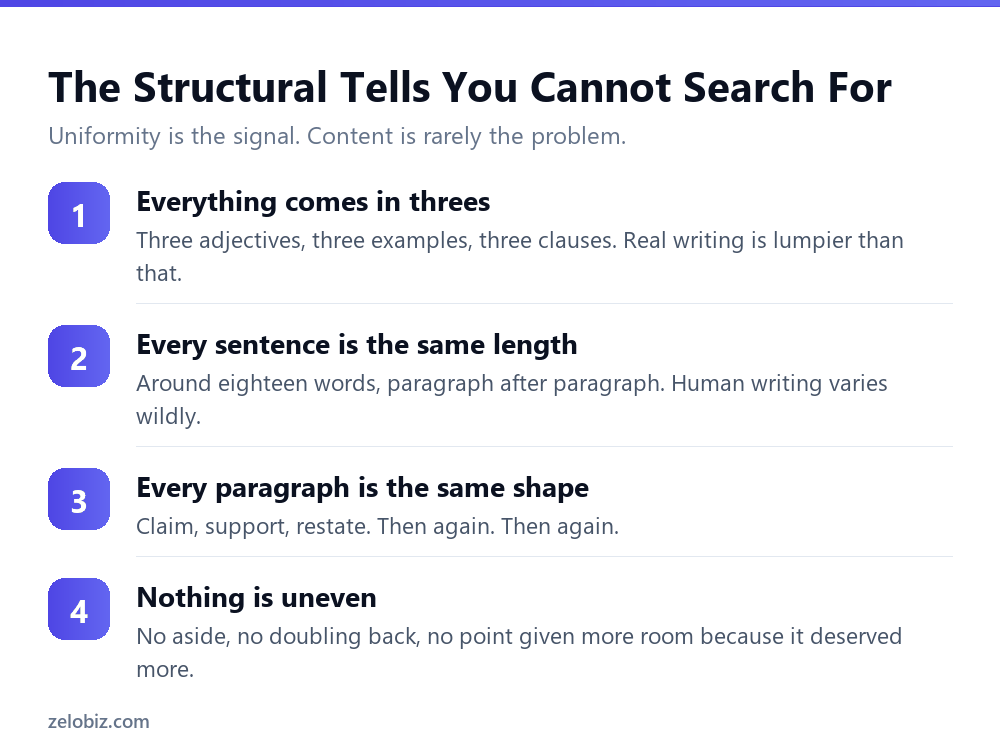
These take slightly more attention because no search finds them, and they matter more than the vocabulary because they persist after every obvious word has been swapped.
Everything arrives in threes
Three adjectives, three bullet points, three examples, three clauses in a sentence. The pattern makes writing feel complete and it appears far more often than the underlying material justifies. When you find a group of three, ask whether the third item earned its place. Often two is the honest number.
Every sentence is the same length
This is the strongest structural signal and the easiest to fix. Generated paragraphs sit in a narrow band of medium length sentences with an even cadence. Real writing lurches. A long sentence that works through something carefully, then a short one. Like that.
Every paragraph has the same shape
Claim, elaboration, restatement of the claim in different words. Once you notice it you cannot stop noticing it. The restatement is usually deletable, and deleting it tightens the paragraph and breaks the pattern at once.
Nothing is uneven
A person writing about something they know gives more room to the parts they find interesting and hurries past the parts they do not. Generated writing distributes attention evenly across every subtopic, which is why it can cover everything and leave no impression.
💡 Pro tip: Read one paragraph aloud. If you can predict the rhythm of the next sentence before you reach it, that is the pattern. Fixing it is usually a matter of splitting one sentence and joining two others.
The Formatting Tells
Two of the strongest signals are not in the words at all. They are in how the text is laid out, which is why they survive a careful edit that only touched sentences.
Every bullet begins with a bolded label
The pattern looks like a bolded phrase, a colon, then a sentence explaining it, repeated down the whole list. It reads as organised and it flattens everything to the same weight. A list a person wrote is lumpier, because some items need a clause and one needs three sentences.
The fix is rarely to reformat the list. More often the list should not be a list. Three short items with bolded labels usually work better as one sentence.
Headings in Title Case
Capitalising Every Main Word In A Heading is a habit generated text falls into regardless of what the surrounding publication does. If your other pages use sentence case, a run of title case headings stands out to a reader before they have read a word of the body.
Bold scattered through the paragraphs
Emphasis applied to several phrases per paragraph stops functioning as emphasis. When everything is important, the bold is decoration, and it is decoration of a very recognisable kind.
⚠️ Watch out: One formatting habit is worse than a style problem. Vague attribution, meaning experts say, studies show, or industry reports suggest with nothing named, is an accuracy problem wearing a style costume. If you cannot name the source, delete the claim rather than softening it.
What Actually Reads as Human
Removing the signals leaves you with clean, neutral text. That is an improvement and it is not the same as sounding like a person. The things that read as human are mostly things a model has no access to.
- Specific, awkward detail. A real figure, a real date, the name of the system that broke. Models round off specifics because the average case has none.
- Unresolved opinion. Saying that something mostly works but still bothers you, without tidying it into a conclusion. Generated text resolves everything.
- Admitted uncertainty. Naming what you do not know is a strong human signal, and it is also more useful to the reader than a confident guess.
- Uneven emphasis. Four paragraphs on the part that matters and one line on the part that does not.
The first of those is the highest yield edit available to you. One concrete particular that only you could have supplied does more for a piece of writing than every word swap in the section above.
⚠️ Watch out: Adding a specific detail means adding a true one. Inventing a plausible statistic or a case study that did not happen fixes the tone and creates a much worse problem. If you do not have a real particular to add, cut the sentence instead of decorating it.
Why Beating a Detector Is the Wrong Target
A lot of people arrive at this question because something flagged their text. It is worth being direct about that, because optimising for a detector leads somewhere unhelpful.
Detection tools produce false positives on human writing, particularly on text by people writing in a second language and on anything highly formulaic such as technical documentation. A score from one of them is evidence of style, not authorship, and treating it as proof of either is a mistake in both directions.
The practical consequence is that chasing a score makes writing worse. People start inserting deliberate errors and odd phrasing to move a number, and end up with text that is harder to read and no more truthful about who wrote it.
📊 Note: Whether you need to disclose AI assistance is a separate question with a real answer, and it depends on your employer, your client agreement, or your institution’s policy. Editing style does not change what those policies require of you.
The better target is writing that is worth reading. Every fix in this article makes text clearer and more specific, which is useful regardless of how the first draft was produced. A human first draft benefits from the same pass.
The Edit Pass, in Order
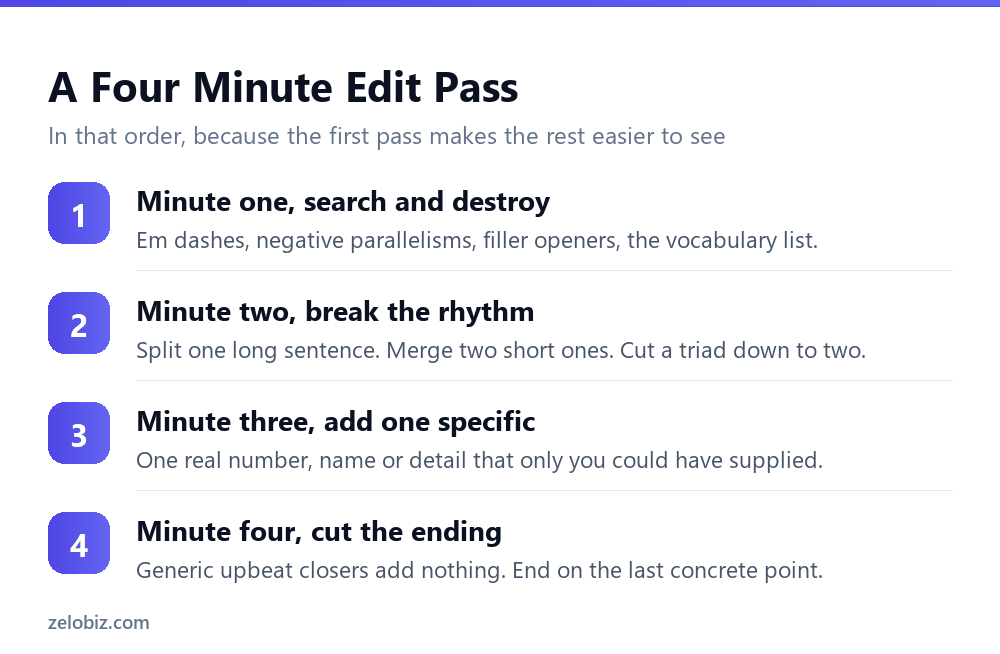
Order matters, because clearing the mechanical problems first makes the structural ones much easier to see.
Run the searches. Then read a paragraph aloud and break the rhythm wherever you can predict it. Then find the one place where a real particular belongs and put it there. Then delete the last paragraph, which in generated text is almost always a summary that restates what you just read in a slightly warmer tone.
That final deletion is worth making a habit. Generated pieces close with something optimistic and non-specific about the future. Stopping on the last concrete point reads better and is faster to write, which is a rare combination.
The same discipline applies before anything gets sent. Our guides to drafting email with Copilot and to Help me write in Gmail both come down to the same instruction: the draft is a starting point, and the specifics have to come from you.
Common Questions
What is the quickest way to make AI writing sound human?
Four searches, in this order: the em dash character, the phrases not just and not merely, filler openers such as it is important to note, and a short list of overrepresented words like delve, robust and testament. That removes most of the obvious signals in under a minute and makes the structural ones visible.
Why does AI writing sound generic rather than wrong?
Because a language model produces the phrasing that fits the widest range of cases. The result is accurate and unspecific at the same time, which reads as bland rather than incorrect. The cure is particulars, not livelier adjectives.
Are em dashes a reliable sign of AI writing?
No. Many editors and journalists use them heavily. They are a signal only alongside other patterns, such as groups of three, uniform sentence length and promotional vocabulary. A single em dash means nothing on its own.
Should I use an AI detector to check my writing?
Not as proof of anything. Detectors produce false positives on human text, especially on writing by people using a second language and on formulaic technical documentation. A score reflects style rather than authorship.
Does adding personality fix AI writing?
Less than adding specifics does. One real number, name or date that only you could have supplied improves a piece more than a paragraph of livelier phrasing. The detail has to be true, since inventing one solves a style problem by creating an accuracy problem.
Why does everything AI writes come in groups of three?
Triads read as complete and balanced, so they are statistically favoured. The fix is to ask whether the third item earned its place. Frequently the honest number is two, and cutting the third both tightens the sentence and breaks the pattern.
What should I do with the last paragraph?
Usually delete it. Generated pieces close with a non-specific optimistic summary that restates the article. Ending on the final concrete point reads better and takes less work.
The Short Version
- →Most tells are findable with a search box. Do those first.
- →Em dashes, not just and not merely, filler openers, and a short word list.
- →Uniform sentence length is the strongest structural signal.
- →Cut groups of three down to two wherever the third did not earn its place.
- →One true specific detail beats every word swap combined.
- →Delete the closing paragraph. It restates what the reader just read.