
Private Cloud Compute explained usually stops at Apple processes some AI requests on its own private servers rather than sending them to a third party. That’s true and it undersells what actually makes the system unusual: Apple built it so outside researchers can check the claim rather than take it on trust.
This covers the five properties Apple’s own engineering team names as requirements for the system, what each actually prevents, and the specific mechanism, publishing production software for public inspection, that turns a privacy policy sentence into something falsifiable.
Short answer: When an Apple Intelligence request needs more processing power than a device has on its own, Private Cloud Compute handles it on Apple’s servers under five named guarantees: the data is used only for that request and never retained, the guarantees are enforced by hardware and software rather than policy alone, no Apple staff have privileged access to bypass the protections, an attacker can’t target a specific user’s request even by compromising a server, and every production software build is published so security researchers can independently verify what’s actually running. Verified directly against Apple’s own security documentation on 5 September 2026.
Five Properties, Each With a Specific Job
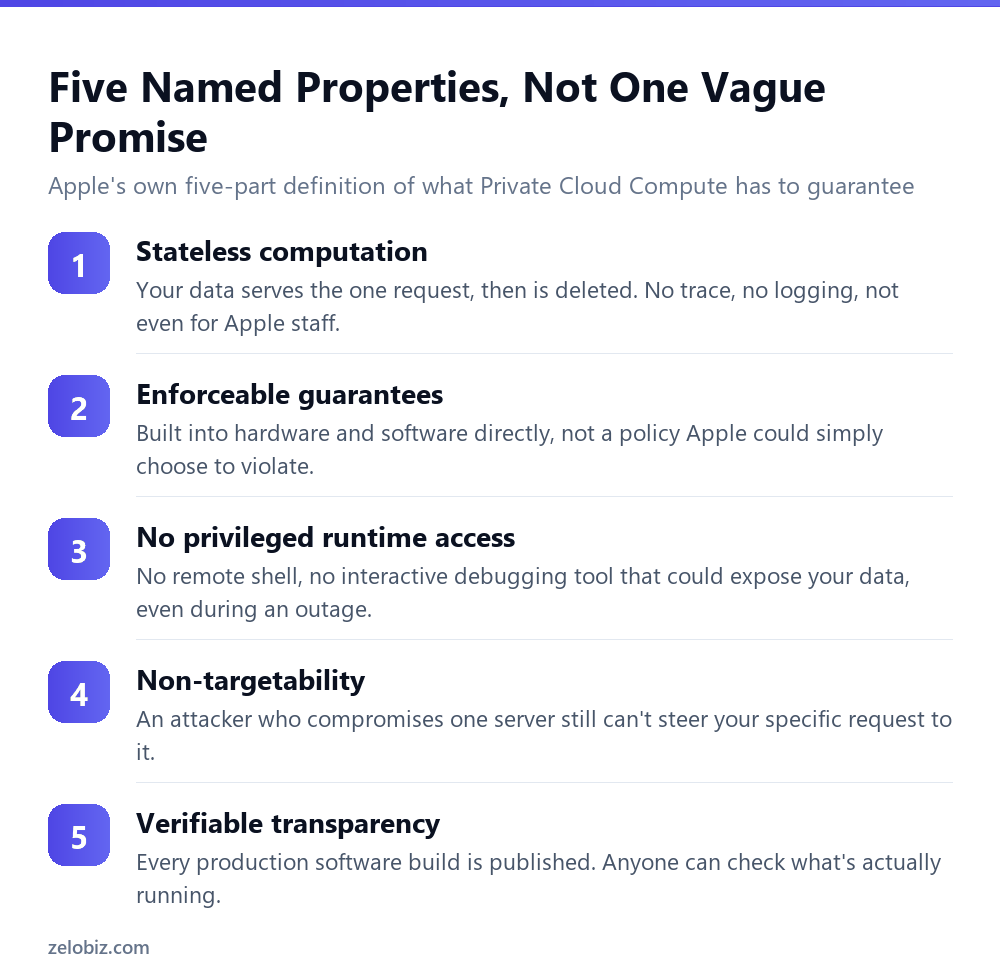
Apple names these five explicitly as what the system has to guarantee, not as marketing language layered on top of a generic cloud service.
Stateless computation
Apple’s own framing is direct: this data must never be available to anyone other than the user, not even to Apple staff, not even during active processing. Data exists only long enough to serve the specific request, then it’s deleted, with no logging or debugging trace left behind in the system afterward.
Enforceable guarantees
Apple states that security and privacy guarantees are strongest when they are entirely technically enforceable. Rather than a policy Apple promises to follow, the protections are built directly into the hardware and software stack, meaning a violation would require breaking the system’s actual design, not just breaking a rule.
No privileged runtime access
The system must not contain privileged interfaces that would let Apple’s own site reliability staff bypass the privacy guarantees. Concretely, that means no remote shells and no interactive debugging tools exist in the system. Apple’s own engineers troubleshooting a live issue don’t have a backdoor into user data, even during an outage.
Non-targetability
An attacker should not be able to attempt to compromise personal data that belongs to specific, targeted Private Cloud Compute users. Through techniques including target diffusion and randomised node selection, even an attacker who successfully compromises individual server hardware can’t steer a particular person’s requests toward that compromised machine.
Verifiable transparency
Security researchers need to be able to verify, with a high degree of confidence, that our privacy and security guarantees match our public promises. This is the property that turns the other four from claims into checkable facts, covered in detail below.
A Promise Versus a Falsifiable Claim
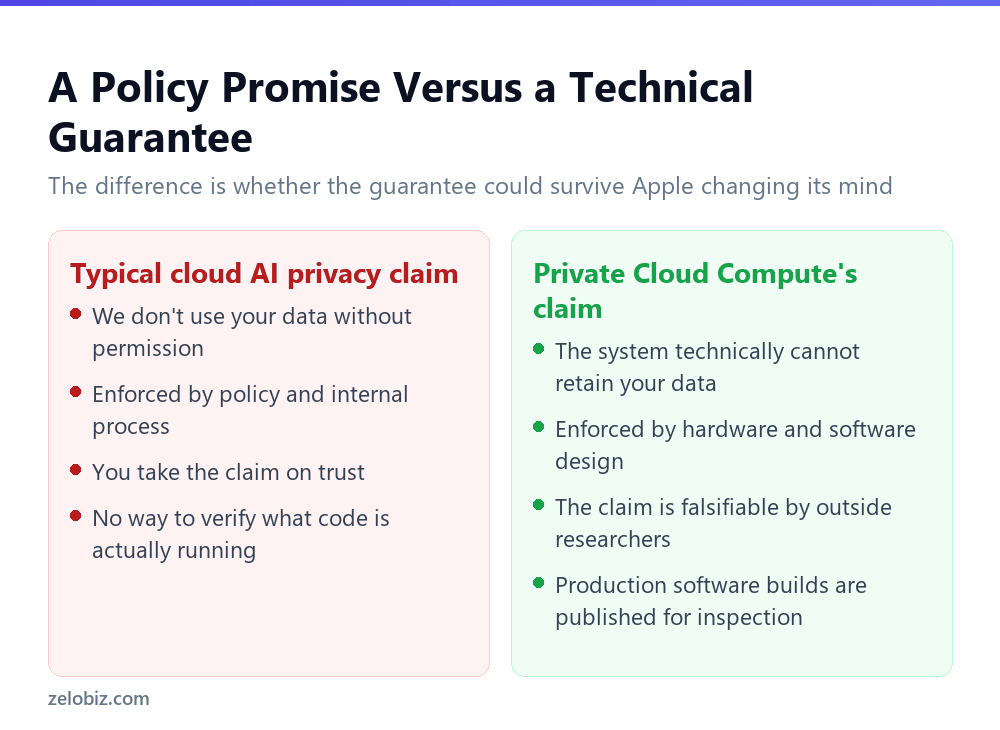
Most cloud AI privacy language, across the industry, reads roughly the same: your data is protected, we don’t use it without permission, we take security seriously. These are policy commitments. They can be true, and they can also change, and from outside there is generally no way to independently confirm what’s actually happening to your data on someone else’s server.
Private Cloud Compute is the first system in this category built around the second column rather than the first. That doesn’t make every claim automatically true simply because Apple states it, but it does mean the claim is structured so someone outside Apple can actually check it, which is a meaningfully different kind of statement.
What the Verification Actually Rests On
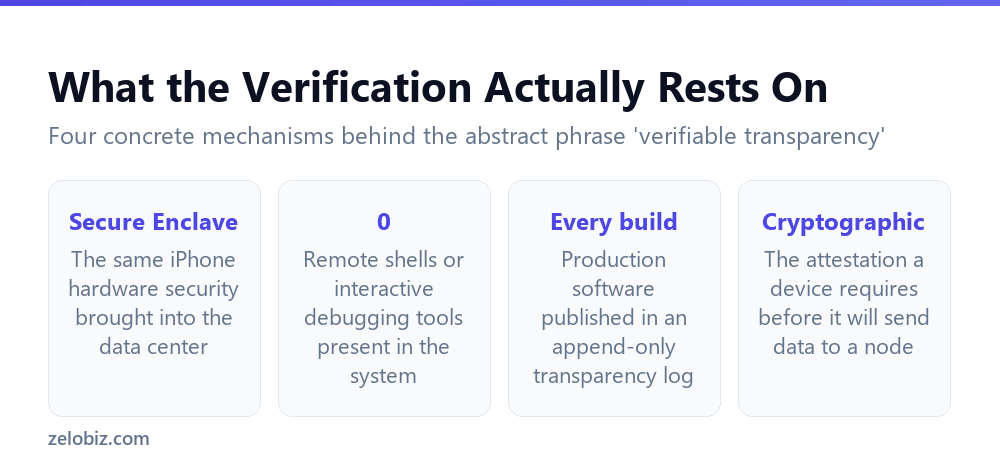
Verifiable transparency isn’t an abstract value statement. Apple describes specific mechanisms that make it operational.
Custom hardware borrowing from the iPhone’s own security model
The root of trust for Private Cloud Compute is custom-built server hardware that brings the power and security of Apple silicon to the data center, using the same hardware security technologies as iPhone, including the Secure Enclave and Secure Boot. The server infrastructure isn’t a separate, less scrutinised system; it’s built on the same security foundation Apple already uses on the device in your pocket.
Published software, not a described process
Apple makes software images of every production build of PCC publicly available for security research. This is the mechanism that makes stateless computation and no privileged runtime access checkable claims rather than assertions: a researcher can examine the actual code running in production, not a description of it.
A device that refuses to talk to unverified servers
User devices willing to send data only to PCC nodes that can cryptographically attest to running publicly listed software closes the loop. It isn’t enough for the published software to be trustworthy in principle; the device itself checks, before sending anything, that the specific server it’s talking to is provably running that exact published, inspected code.
⚠️ Watch out: None of this means Private Cloud Compute is beyond scrutiny or immune to future vulnerabilities. What it means is that the claims are structured to be checkable, and ongoing independent security research against the published builds is the actual mechanism that keeps the guarantee honest over time, not a one-time audit.
📊 Note: This system is specifically for requests that need more capability than on-device processing can provide. Requests Apple Intelligence can fully handle on the device itself don’t invoke Private Cloud Compute at all, and separately, requests routed to ChatGPT follow an entirely different data model, covered in its own article.
When a Request Actually Uses Private Cloud Compute
Not every Apple Intelligence request leaves the device at all, and understanding that distinction matters for judging how often any of this actually applies to you day to day.
Apple’s on-device models handle a substantial share of everyday tasks, things like basic text summarisation, notification prioritisation, and simpler writing assistance, entirely locally, with nothing sent anywhere. Private Cloud Compute is reserved for requests that genuinely need more computational power than the device’s own neural engine can provide within the constraints of battery life and responsiveness.
The practical takeaway is that Private Cloud Compute’s guarantees matter most for the more demanding requests you make, and for those, the five properties above are exactly the ones worth understanding rather than treating as background technical detail.
Why This Matters More Than a Single Feature
Private Cloud Compute is infrastructure, not a feature you turn on. It sits underneath whichever Apple Intelligence capability needs more than the device alone can provide, which means understanding it once tells you something about a wide range of individual features rather than requiring you to evaluate each one’s privacy model separately.
It’s also worth being precise about scope. This system governs requests Apple processes on its own infrastructure. It has nothing to do with what happens when Siri hands a request to ChatGPT instead, which runs under a completely different, separately documented set of rules covered in ChatGPT in Siri: what changes the moment you sign in. Knowing which system actually handled a given request is worth confirming rather than assuming, since the privacy model differs meaningfully between them.
What Independent Verification Has Actually Found
A published system is only meaningfully verifiable if researchers actually examine it, and Apple’s approach anticipates ongoing scrutiny rather than a single launch-day audit. The transparency log is described as append-only specifically so that a history of what was published, and when, remains checkable over time rather than something Apple could quietly revise.
This matters because a security claim that was true at launch and unchecked afterward isn’t the same guarantee as one under continuous, ongoing independent review. The value of publishing production builds isn’t the one-time act of publishing; it’s that the practice creates a standing invitation for researchers to keep checking, release after release, rather than trusting an initial audit to still apply indefinitely.
📊 Note: This article describes the architecture Apple states it has built, based on Apple’s own published documentation. Whether independent security research has found issues with specific implementations is a separate, evolving question worth following through security research sources directly rather than assuming permanence either way.
The broader point holds regardless of any specific finding either way: a system designed to be checked is a fundamentally different kind of commitment than a system asking to be trusted, and that design choice is worth recognising on its own merits separately from whatever any individual audit concludes at any given moment.
Common Questions
What is Private Cloud Compute?
The system Apple uses to process Apple Intelligence requests on its own servers when a device alone can’t handle them, built around five named guarantees: stateless computation, enforceable guarantees, no privileged runtime access, non-targetability, and verifiable transparency.
Can Apple employees see my data when it’s processed through Private Cloud Compute?
Apple states the system contains no privileged interfaces that would let its own site reliability staff bypass the privacy guarantees, with no remote shells or interactive debugging tools present.
Is Private Cloud Compute’s privacy claim actually verifiable, or is it just a policy promise?
Apple makes software images of every production build publicly available for security research, meaning independent researchers can inspect the actual code running in production rather than relying on a described policy.
What happens to my data after Private Cloud Compute processes a request?
Apple states the data serves only the immediate request and is deleted upon completion, with no trace left through logging or debugging, not even accessible to Apple staff during active processing.
Can an attacker target a specific person’s data on Private Cloud Compute?
Apple states the system is designed so an attacker can’t compromise data belonging to specific, targeted users, using techniques including target diffusion and randomised node selection, even if individual server hardware is compromised.
How does a device know it’s talking to a genuine, unmodified Private Cloud Compute server?
Devices only send data to nodes that can cryptographically attest to running publicly listed, published software, so the device itself checks before transmitting anything.
Does Private Cloud Compute apply to ChatGPT requests through Siri?
No. ChatGPT requests follow a separate, differently documented data model governed by Apple’s agreement with OpenAI, not Private Cloud Compute’s guarantees.
The Short Version
- →Private Cloud Compute handles Apple Intelligence requests too demanding for the device alone.
- →Data is used only for the immediate request, then deleted, with no trace or logging.
- →No privileged interface exists for Apple staff to bypass the privacy guarantees.
- →An attacker can’t target a specific user’s data even by compromising a server.
- →Apple publishes every production software build for independent security research.
- →Devices verify a server’s software cryptographically before sending it any data.