

To write a contract that actually protects both sides, identify both parties by their full legal names, define the scope of work specifically — including what’s explicitly not included — state clear payment terms and a timeline, include a termination clause describing how either party can end the agreement, and have it signed and dated by authorized representatives on both sides. Specificity throughout is what actually provides real protection — vague language protects no one once an actual dispute arises.
The core elements a real contract needs
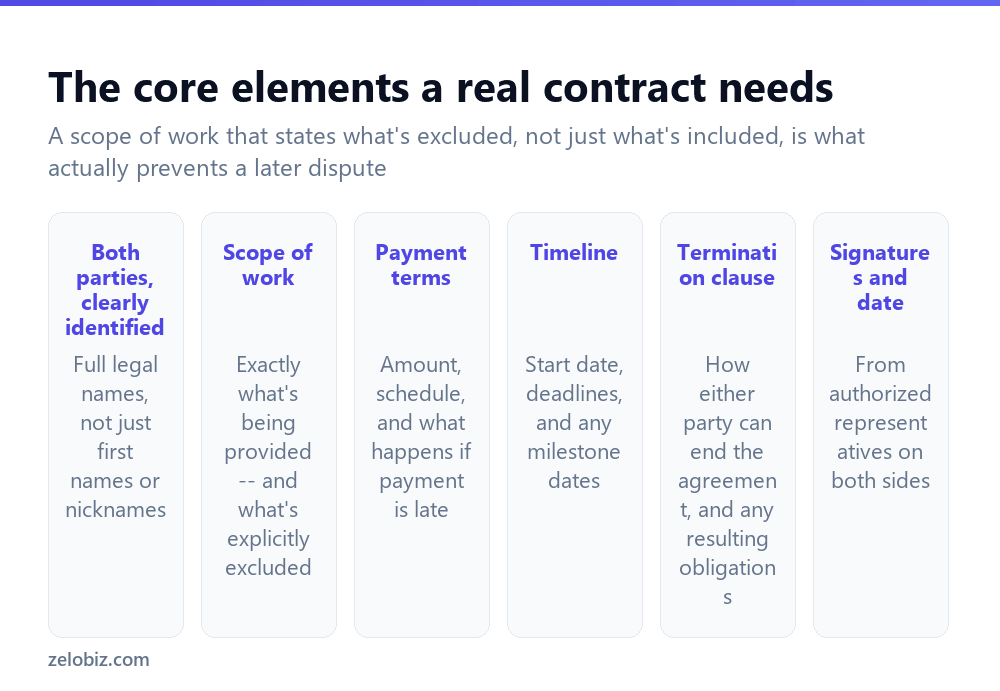
Both parties, clearly identified — full legal names (and full legal business names, if applicable, not just a nickname or informal name used casually in conversation), removing any possible ambiguity about who is actually bound by the agreement.
Scope of work — specifically what’s being provided, and genuinely just as important, what’s explicitly excluded. Most contract disputes live in the gap between what one party assumed was included and what the other party actually intended to provide.
Payment terms — the amount, the payment schedule, and what happens specifically if a payment is late.
Timeline — a start date, deadlines, and any interim milestone dates relevant to the work.
Termination clause — how either party can actually end the agreement before its natural completion, and what obligations (partial payment for work already done, return of materials, and similar) result if that happens.
Signatures and date — from someone actually authorized to bind each party, since a contract signed by someone without genuine authority to agree to it on their organization’s behalf can create real enforceability questions later.
Specificity is what actually protects you in a contract, not length or ceremonial legal-sounding language. A short, specific contract genuinely protects both sides better than a long one full of vague, generic boilerplate that doesn’t actually address the real specifics of the situation at hand.
Writing a contract that holds up
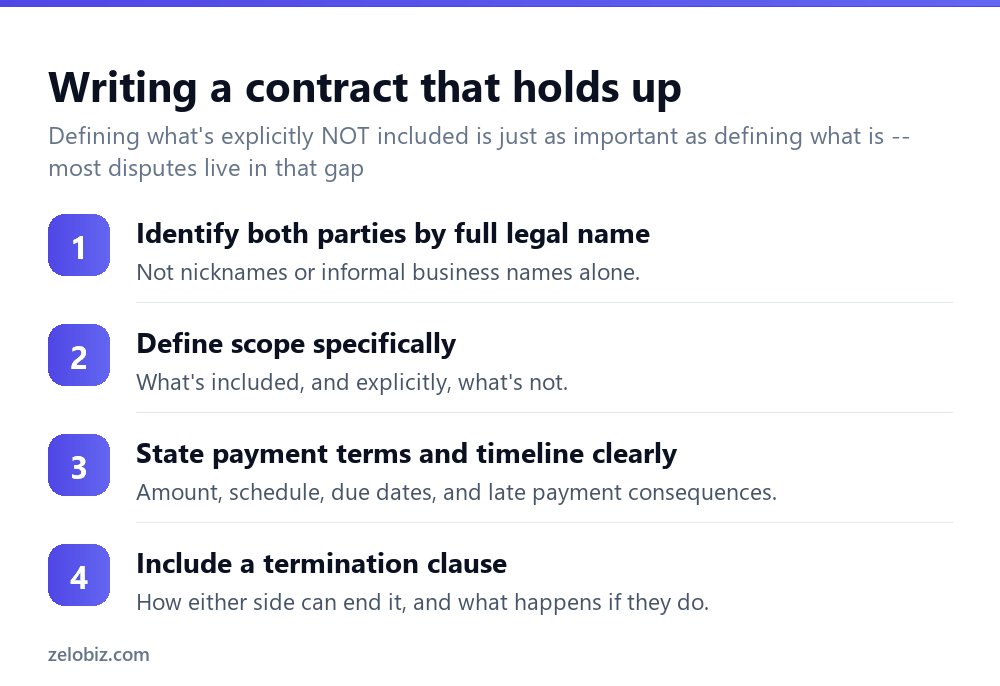
Identify both parties by full legal name at the very start of the document — not nicknames, not informal business names used casually, the actual full legal identification for each side.
Define scope specifically — what’s included, described in concrete terms rather than broad generalities, and explicitly what’s not included, closing off the most common source of later disagreement before it can happen.
State payment terms and timeline with genuine clarity — exact amounts, exact dates, and what specifically happens if either payment or the timeline itself slips.
Include a termination clause — describing specifically how either party can end the agreement, and what obligations result from doing so, rather than leaving this genuinely important scenario entirely unaddressed.
When to use a template vs hiring a lawyer
For straightforward, lower-stakes agreements — a simple freelance project, a basic service agreement with a small, known client — a well-built, genuinely adapted template can be entirely sufficient, provided the specific details of the actual agreement are properly filled in rather than left generic.
For anything with genuinely significant stakes — a large contract value, complex or unusual terms, anything involving intellectual property rights, equity, or a relationship expected to last years — consulting an actual lawyer, even briefly to review a draft rather than writing one entirely from scratch, is worth the cost relative to the real risk of a poorly written agreement in a genuinely high-stakes situation.
A worked example: a freelancer’s first client contract
Say a freelance web developer has just agreed verbally with a small business owner to build a five-page website, and now needs to turn that verbal agreement into an actual written contract before starting work.
They start by identifying both parties by full legal name — their own registered business name as the developer, and the client’s full legal business name, not just the storefront name the client uses casually in conversation. Getting this detail right at the outset avoids any later question about who exactly is bound by the agreement if either side is a registered business entity rather than an individual.
For scope, rather than writing “build a website,” they specify exactly what’s included: five pages, one round of revisions, delivery of source files, and mobile responsiveness — and just as importantly, what’s excluded: ongoing maintenance, additional revision rounds beyond the first, and content writing, since the client is expected to supply their own text and images. This explicit exclusion list is what prevents the most common source of freelance disputes — a client assuming something was included that the developer never actually intended to provide for the agreed price.
Payment terms specify 50% upfront before work begins and the remaining 50% due within 7 days of final delivery, with a stated late fee if the final payment isn’t made within 30 days. The timeline states a start date and a specific delivery deadline, rather than an open-ended “as soon as possible.” The termination clause states that if either party ends the agreement early, the developer keeps the upfront deposit and delivers whatever work is completed to that point, which protects the developer’s time already invested while giving the client a defined exit if circumstances change.
Both sides sign and date the final document before any work actually begins — not after the first draft is delivered, since starting work before the contract is finalized removes much of the document’s practical protective value for both sides.
Contracts for recurring or ongoing work
For a relationship expected to continue past a single project — a monthly retainer, ongoing maintenance, or a series of separate projects with the same client — a master services agreement covering the general terms (payment terms, termination, confidentiality, and similar) paired with a shorter statement of work for each individual project is often more practical than writing an entirely new full contract every time. The master agreement stays constant across the relationship, while each statement of work specifies just the scope, timeline, and price for that particular piece of work, referencing back to the master agreement’s general terms rather than repeating them.
This two-document approach also makes it considerably easier to adjust just the project-specific details for new work without needing to renegotiate the entire relationship’s terms each time a new, smaller project comes up.
What happens without a written contract
A verbal agreement can, in many jurisdictions, still be legally binding, but proving its exact terms after the fact — particularly around scope, price, and deadlines — becomes genuinely difficult once each side remembers the conversation somewhat differently, which is precisely the situation a written contract is designed to prevent before it can happen. Even a short written agreement, well short of a formal, lawyer-drafted contract, provides meaningfully more protection and clarity than relying on memory of a verbal understanding once real money and real deliverables are involved.
Common weaknesses to avoid
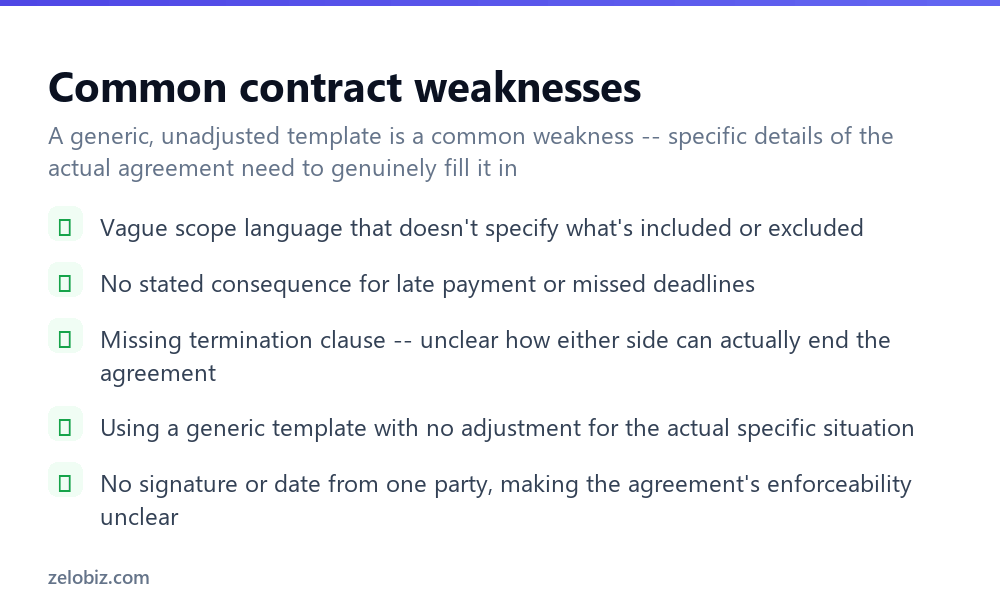
Vague scope language — not specifying clearly what’s included or excluded is the single most common source of later disputes.
No stated consequence for late payment or missed deadlines — leaves genuinely no clear recourse or expectation if either happens, beyond an informal, awkward conversation after the fact.
Missing termination clause — unclear how either side can actually end the agreement if circumstances change, leaving a real gap in an otherwise reasonable agreement.
Using a generic template with no real adjustment — specific details of the actual agreement genuinely need to fill in a template’s placeholders, not be left as generic boilerplate that doesn’t reflect the real situation.
Missing a signature or date from one party — makes the agreement’s actual enforceability genuinely unclear if it’s ever disputed later.
- ✓Identify both parties by full legal name, not nicknames or informal names
- ✓Define scope specifically, including what’s explicitly excluded
- ✓State clear consequences for late payment or missed deadlines
- ✓Include a genuine termination clause describing how either side can exit
- ✓Consult an actual lawyer for anything with genuinely significant stakes
- ✕Using vague, generic scope language that doesn’t specify what’s actually included
- ✕Leaving payment or deadline consequences entirely unaddressed
- ✕Skipping a termination clause and leaving that scenario unaddressed
- ✕Using a generic template without genuinely adjusting it to the real situation
- ✕Finalizing a high-stakes agreement without any legal review at all
Frequently asked questions
How do I write a contract?
Identify both parties by full legal name, define scope specifically including what’s excluded, state clear payment terms and a timeline, include a termination clause, and have it signed and dated by authorized representatives.
What makes a contract actually protective?
Specificity throughout, particularly in the scope of work — vague language protects no one once an actual dispute arises.
Should I use a contract template or hire a lawyer?
A well-adapted template is often sufficient for straightforward, lower-stakes agreements. Significant stakes or complex terms are worth a lawyer’s review.
Why does defining what’s excluded from scope matter as much as what’s included?
Most contract disputes happen in the gap between what one party assumed was included and what the other actually intended to provide.
What happens if a contract has no termination clause?
It leaves genuinely unclear how either party can actually end the agreement if circumstances change, which is a real gap worth addressing upfront.
Who needs to sign a contract for it to be valid?
Someone actually authorized to bind each party — a signature from someone without genuine authority can create real enforceability questions later.
- →Turn an accepted proposal into a contract: how to write a proposal
- →Bill for work under the contract: how to create an invoice
- →Set up the business entity signing the contract: how to start an LLC
- →Register the business name used in agreements: how to register a business name